
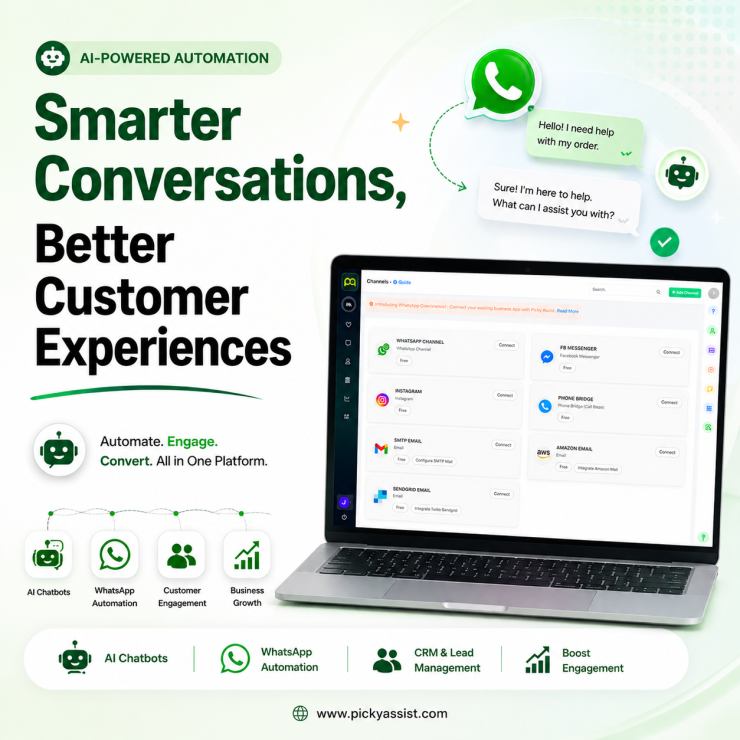
People no longer want to wait hours for replies, search through multiple pages for answers, or repeat their questions to different support teams. They expect businesses to respond quickly, understand their needs, and provide helpful solutions at every interaction. This shift has made artificial intelligence a major part of modern customer communication. An AI chatbot for business helps companies automate conversations, handle customer queries, support sales teams, and create smoother customer experiences without increasing operational workload.
However, the real value of AI chatbots is not simply answering questions automatically. The strongest business applications combine automation, customer data, and human support to create meaningful conversations.
For companies using channels like WhatsApp, AI-powered chat solutions can help manage enquiries, qualify leads, provide instant responses, and support customers throughout their journey.
Platforms like Picky Assist help businesses build automated conversational workflows, manage customer interactions, and connect messaging with CRM processes so teams can focus on higher-value tasks.
What is an AI Chatbot for Business?
An AI chatbot is a software solution that uses artificial intelligence to understand customer messages and respond with relevant information. Unlike traditional rule-based bots that only follow fixed paths, modern AI chat systems can understand context, recognize customer intent, and guide users toward the right action.
Businesses use AI chatbots to manage:
- Customer support questions
- Product enquiries
- Lead qualification
- Appointment scheduling
- Order updates
- Sales assistance
- Frequently asked questions
A modern chatbot for business use is designed to improve customer experience while reducing repetitive manual work. The goal is not to replace people. Instead, it helps teams handle conversations more efficiently.
Why Are Businesses Adopting AI Chatbots?
Businesses across industries are adopting AI-powered conversations because customer communication has become more demanding.
Faster Customer Response
Customers often make decisions based on how quickly a business responds. An AI assistant can provide immediate answers for common questions, even outside business hours. This improves accessibility and reduces delays.
For example:
A customer asking about pricing, availability, or service details can receive instant guidance instead of waiting for a sales representative.
Reduce Repetitive Work
Support teams often spend hours answering the same questions repeatedly. AI automation can handle routine requests such as:
- Business hours
- Service information
- Order status
- Basic troubleshooting
- Appointment details
This allows employees to focus on conversations that require human expertise.
Improve Lead Management
Many businesses lose potential customers because enquiries are not followed up at the right time.
An AI system can:
- Capture customer information
- Understand customer intent
- Ask qualifying questions
- Route conversations to the right team
This creates a smoother sales process.
AI Chatbot vs Traditional Chatbot
Not all chatbots work the same way.
Traditional Chatbots
Traditional bots usually depend on predefined rules. They work well for:
- Fixed questions
- Simple menus
- Basic workflows
However, they may struggle when customers ask questions outside the expected flow.
AI-Powered Chatbots
AI-based chatbot systems can understand variations in customer language and provide more flexible responses. They can help businesses create more natural conversations by understanding:
- Customer intent
- Context
- Previous interactions
- Different ways people ask questions
This makes AI more suitable for growing businesses managing large numbers of conversations.
How an AI Chatbot Helps Different Business Functions?
An AI chatbot is not only a customer support tool. It can support multiple areas of business operations.
Customer Support
Customer Support teams can use AI to answer common questions instantly and guide customers through solutions.
Examples:
- Product information
- Service instructions
- Policy details
- Troubleshooting assistance
For complex issues, the conversation can be transferred to a human team member.
Sales Assistance
Sales teams can use AI conversations to identify interested customers and collect important information before a salesperson joins. For example, a bot can ask:
- What product are you interested in?
- What is your preferred budget?
- When do you want to purchase?
This helps sales teams prioritize valuable opportunities.
Marketing Engagement
Marketing teams can use AI conversations to:
- Share offers
- Recommend products
- Collect feedback
- Re-engage customers
When combined with customer insights, AI becomes a powerful engagement tool.
Real Business Use Cases of AI Chatbots
The best AI chatbot strategies focus on solving specific business problems.
E-commerce Businesses
Online stores can use AI chat solutions for:
- Product discovery
- Customer questions
- Order assistance
- Post-purchase support
Example:
Customer:
“Do you have this product in another size?”
AI assistant:
“Yes, this item is available in three sizes. Would you like help selecting one?”
This creates a faster buying experience.
Healthcare and Wellness Businesses
Healthcare providers can use AI assistants for:
- Appointment requests
- General information
- Patient communication
Example:
“Can I book a consultation this week?”
The assistant can collect basic details and help move the conversation forward.
Education and Training Institutes
Educational organizations can automate:
- Course enquiries
- Admission information
- Schedule details
- Student support
Instead of manually answering the same questions, teams can focus on student guidance.
Travel Businesses
Travel companies receive many repetitive enquiries about:
- Destinations
- Packages
- Availability
- Booking process
AI conversations can help customers discover suitable options while collecting their preferences.
Choosing the Best Chatbot for Business Growth
Selecting the right solution depends on business goals, communication volume, and customer expectations. The best chatbot for business should provide more than automated replies. Important capabilities include:
Natural Conversation Handling
The chatbot should understand customer intent instead of forcing users through complicated menus.
Integration With Business Systems
A useful chatbot should connect with:
- CRM platforms
- Customer databases
- Sales workflows
- Communication channels
Human Handover Options
Automation works best when customers can easily reach a team member when needed.
Analytics and Improvement
Businesses should be able to understand:
- Common customer questions
- Conversation performance
- Customer behaviour patterns
This helps improve future interactions.
How AI Chatbots Improve Customer Journeys?
A customer journey usually involves multiple touchpoints. A potential customer may:
- Discover a product
- Ask questions
- Compare options
- Request support
- Make a purchase
An AI assistant can support each stage by providing timely information. This creates a smoother experience and reduces friction during decision-making.
AI Chatbot Business Applications That Drive Results
An AI chatbot becomes valuable when it solves real business challenges. The most successful implementations focus on specific outcomes.
Lead Qualification and Sales Support
Many businesses receive enquiries from multiple channels, but not every lead is ready to buy immediately.
An AI chatbot business workflow can help identify:
- Customer requirements
- Purchase intent
- Budget range
- Preferred solutions
Instead of spending time on basic qualification, sales teams can focus on customers who need personal assistance.
Customer Onboarding
First impressions matter. A chatbot can guide new customers through the early stages of their relationship with a brand.
Examples:
- Welcome messages
- Product instructions
- Account setup guidance
- Service information
A smooth onboarding process increases customer confidence.
Customer Retention
Existing customers often need reminders, updates, and support.
AI-powered communication can help businesses maintain engagement through:
- Renewal reminders
- Feedback collection
- Product education
- Support assistance
Retention becomes easier when customers feel supported after the purchase.
What Makes a Good WhatsApp Business Chatbot?
A successful chatbot experience depends on design and strategy. A strong WhatsApp business chatbot should:
Understand Customer Intent
Customers rarely ask questions in the exact same way. AI should recognize different variations and provide helpful responses.
Provide Clear Next Steps
Every conversation should guide users toward an action:
- Book a demo
- Request information
- Talk to an expert
- Complete a purchase
Maintain Brand Voice
The chatbot should communicate in a way that matches the business personality. A premium brand and a casual consumer brand may require different conversation styles.
How Picky Assist Helps Businesses Build AI-Powered Conversations?
Building a chatbot is only one part of successful automation. Businesses also need a system to manage customer relationships after conversations begin. Picky Assist helps businesses create connected customer experiences through:
No-Code Chatbot Creation
Businesses can design conversational flows without requiring advanced technical skills.
Unified Customer Communication
Teams can manage customer interactions from a centralized workspace.
CRM-Based Engagement
Customer information can be organized to support better follow-ups and personalized conversations.
Workflow Automation
Businesses can automate repetitive processes and allow teams to focus on more important customer interactions.
Conclusion
An AI chatbot for business has become a practical solution for companies that want faster customer service, better lead management, and more efficient communication. From answering customer questions to supporting sales teams, AI chat solutions help businesses create smoother customer journeys.
However, successful chatbot implementation requires more than technology. Businesses need clear goals, thoughtful conversation design, and the right platform to connect automation with customer relationships. Picky Assist helps businesses build smarter communication workflows by combining chatbot automation, customer management, and conversational tools.
As customer expectations continue to rise, businesses that create faster and more personalized conversations will have a stronger advantage in building long-term customer relationships.
FAQs on AI Chatbot for Business
1. What is an AI chatbot for business?
An AI chatbot for business is a software solution that uses artificial intelligence to communicate with customers, answer questions, automate tasks, and support sales or service operations. It helps businesses provide faster responses while reducing repetitive manual work.
2. How can businesses use AI chatbots?
Businesses use AI chatbots for:
- Customer support
- Lead generation
- Sales assistance
- Appointment scheduling
- Product recommendations
- Customer onboarding
The use depends on the business model and customer journey.
3. What is the difference between a chatbot and an AI chatbot?
A traditional chatbot follows predefined rules, while an AI chatbot can understand customer intent and handle more flexible conversations. AI systems can provide more natural interactions by using context and conversational understanding.
4. Can an AI chatbot work with WhatsApp?
Yes. Businesses can use WhatsApp-based AI chat solutions to automate conversations, answer customer questions, and support sales or service workflows. A WhatsApp chatbot can also connect with business processes through integrations.
5. Is an AI chatbot suitable for small businesses?
Yes. Small businesses can use AI chatbots to manage customer enquiries, respond faster, and reduce repetitive tasks. As the business grows, automation helps teams handle larger communication volumes.
6. What should businesses look for in chatbot software companies?
Businesses should evaluate chatbot providers based on:
- Ease of building workflows
- Integration options
- CRM capabilities
- Automation features
- Support for business communication channels
The right platform should match both current and future needs.
7. Can AI chatbots improve sales conversions?
Yes. AI chatbots can help by responding instantly, qualifying leads, recommending products, and guiding customers toward the next step. Better response times often create better opportunities for conversion.
8. How does Picky Assist help with AI chatbot implementation?
Picky Assist helps businesses create automated customer journeys, manage conversations, and connect messaging workflows with customer relationship processes. It enables businesses to use automation while keeping customer communication organized and efficient.

Add comment