
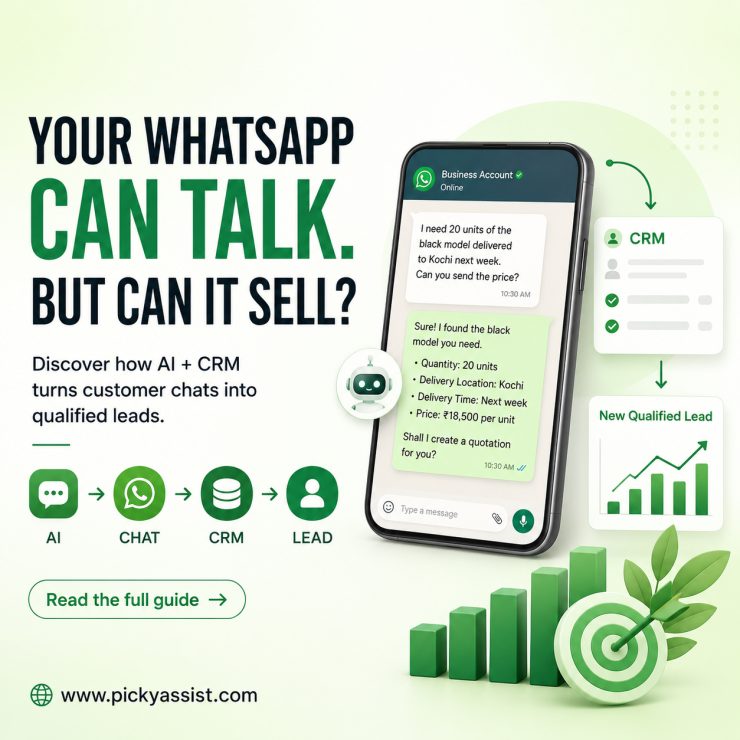
A sales agent receives a WhatsApp message asking for pricing, product availability, delivery time, and a quotation. Instead of answering each question manually, an AI agent can understand the conversation and take the next step. That is where a ChatGTP agent more accurately, ChatGPT agent inside a WhatsApp CRM becomes useful. It combines conversational AI with customer records, workflows, automation, and human-agent support.
A ChatGPT agent inside a WhatsApp CRM uses AI to understand customer conversations and assist with tasks such as answering questions, qualifying leads, retrieving information, and triggering workflows. The CRM provides customer context and business rules, while WhatsApp provides the communication channel.
What is a ChatGPT agent in WhatsApp CRM?
A ChatGPT agent in WhatsApp CRM is an AI-powered conversational layer connected to a business’s WhatsApp and CRM environment.
Instead of responding only to predefined chatbot buttons, the agent can interpret natural-language requests and determine what information or action is required.
For example, a customer might write:
“I need 20 units of the black model delivered to Kochi next week. Can you send the price?”
A basic chatbot may struggle with the sentence structure. An AI agent can identify the product, quantity, location, timeframe, and pricing request.
The CRM can then store or use those details within the appropriate workflow.
OpenAI’s ChatGPT agent is an agentic capability designed to complete multi-step tasks using tools and a virtual computer.
A ChatGPT-powered agent inside a WhatsApp CRM is a business implementation concept. It does not mean the consumer ChatGPT application itself has been placed inside WhatsApp.
How does an AI agent work inside WhatsApp CRM?
A practical architecture looks like this:
Customer → WhatsApp → AI agent → CRM data → Business workflow → Human agent or automated action
The agent can interpret the customer’s message and use available business context.
| Customer requirement | AI agent action | CRM outcome |
|---|---|---|
| Product question | Understand intent and answer | Update interest |
| Pricing request | Retrieve approved information | Create or qualify lead |
| Appointment request | Check available workflow/integration | Trigger booking process |
| Order question | Identify customer and order | Provide status or escalate |
| Complex complaint | Detect escalation need | Assign human agent |
| Lead qualification | Ask relevant questions | Update lead fields |
The key advantage is context. An AI agent should not treat every WhatsApp message as an isolated question. It should use relevant customer information, conversation history, and approved business knowledge.
Why put ChatGPT inside a WhatsApp CRM?
A standalone AI chatbot can answer questions. A CRM-connected AI agent can help move the conversation toward a business outcome.
Consider a real estate enquiry.
A customer sends:
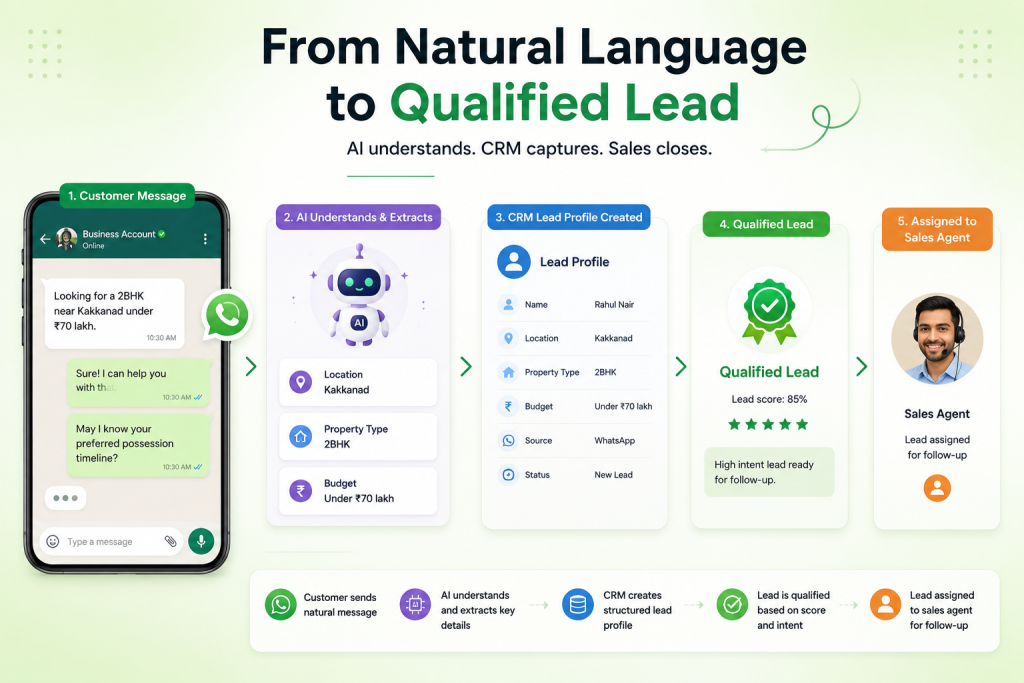
“Looking for a 2BHK near Kakkanad under ₹70 lakh.”
The agent could identify the customer’s requirements, ask qualification questions, capture the details in the CRM, and route the lead to an appropriate salesperson.
The human agent then receives a more useful lead instead of starting the conversation from zero.
This is where conversational AI becomes operational automation.
What can a WhatsApp AI agent automate?
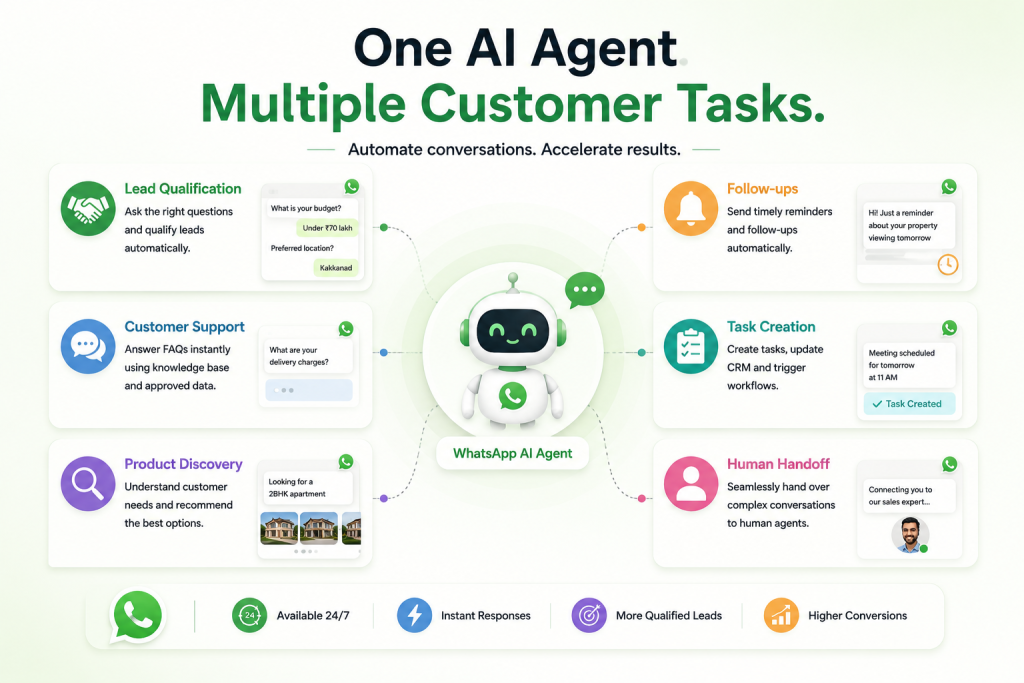
The most useful applications usually involve repetitive but variable conversations.
1. Lead qualification
The agent can ask about budget, location, product preference, timeline, or other qualifying information.
2. Customer support
It can answer frequently asked questions using an approved knowledge source and escalate exceptions.
3. Product discovery
Customers can describe what they need naturally instead of navigating rigid menus.
4. Follow-up workflows
When a conversation reaches a defined stage, the CRM can trigger an appropriate follow-up workflow.
5. Internal task creation
A conversation can create a lead, support task, appointment request, or other CRM activity when the workflow supports it.
6. Human handoff
The agent can transfer conversations when the request requires judgment, negotiation, sensitive handling, or manual intervention.
What should remain with human agents?
AI should not automatically handle every customer interaction.
Human intervention remains important for:
- Complaints requiring judgment
- Refund or compensation decisions
- Negotiation
- Sensitive customer issues
- High-value sales
- Ambiguous requests
- Exceptions outside documented business rules
A good architecture defines when the AI should stop.
The handoff should also preserve conversation context. Otherwise, the customer may need to repeat everything to the human agent.
WhatsApp rules that still apply
Adding AI does not remove WhatsApp Business Platform requirements.
Businesses using the WhatsApp Business Platform must still operate within applicable messaging policies and business messaging requirements. WhatsApp positions its Business Platform for medium and large businesses communicating with customers programmatically.
For outbound messaging, businesses must also account for the applicable template requirements and message categories. Marketing and utility messages should not be treated as interchangeable.
The customer-service window also affects how businesses design automated replies and outbound follow-ups. Therefore, an AI agent should sit inside a compliant messaging architecture rather than operate as an unrestricted messaging bot.
Common mistakes when adding AI to WhatsApp CRM
1. Giving the agent unrestricted information
Why it happens: Teams want the AI to answer everything.
Consequence: The agent may provide unsupported or outdated information.
Better approach: Give the agent controlled business knowledge and define what it cannot answer.
2. Automating before mapping the workflow
Why it happens: AI looks easier to deploy than workflow design.
Consequence: Customers get irrelevant questions or circular conversations.
Better approach: Define intents, actions, escalation points, and CRM fields first.
3. Removing human handoff
Why it happens: Businesses focus entirely on reducing agent workload.
Consequence: Complex conversations become frustrating.
Better approach: Create explicit escalation triggers.
4. Ignoring CRM data quality
Why it happens: Teams assume AI will compensate for poor data.
Consequence: The agent works with incomplete or incorrect context.
Better approach: Maintain clean customer records and clearly defined fields.
How to evaluate a ChatGPT agent for WhatsApp CRM?
Before implementation, ask:
- Can it understand natural-language customer requests?
- Can it access approved business information?
- Can it use CRM context?
- Can it trigger defined workflows?
- Can it update customer information?
- Can it transfer conversations to humans?
- Can managers review conversations?
- Can the business test failure scenarios?
- Can outbound messaging remain compliant?
Picky Assist can be considered when a business wants to combine WhatsApp conversations with CRM, chatbot, and workflow automation in one operating environment.
Conclusion
A ChatGPT agent inside WhatsApp CRM is more useful than simply adding AI-generated replies.
The real value comes from connecting conversation, customer context, CRM data, automation, and human intervention.
Start with repetitive customer journeys. Give the AI clear boundaries, connect it to reliable business information, and define human handoff rules before scaling.
FAQs on ChatGTP agent in WhatsApp CRM
A ChatGTP agent, commonly spelled ChatGPT agent, is an AI-powered conversational layer that can operate within a WhatsApp CRM workflow. It can understand customer requests, use approved business context, and support automated or human-assisted actions.
Yes, ChatGPT-based AI capabilities can be integrated into business messaging workflows through appropriate technical integrations and platform architecture. The exact capabilities depend on the WhatsApp CRM and AI implementation.
A ChatGPT-powered agent can help answer questions, qualify leads, interpret customer requests, retrieve approved information, and trigger supported workflows. Businesses should define clear limits and human escalation rules.
They serve different purposes. A traditional chatbot often follows predefined flows, while an AI agent can interpret more flexible natural-language requests and determine the next appropriate step.
Yes, if the WhatsApp CRM and integration allow the agent to access and update relevant CRM fields. Businesses should restrict updates to defined fields and test the workflow before production use.
Yes. Human handoff is an important part of a reliable AI workflow. Businesses should define triggers for escalation and preserve relevant conversation context during the transfer.
No. An AI agent can handle repetitive conversations and qualification tasks, but human agents remain important for negotiation, complex requests, complaints, and high-value interactions.
No. ChatGPT agent refers to agentic AI capabilities, while a WhatsApp chatbot is a customer-facing conversational interface. A WhatsApp CRM can combine chatbot workflows with AI capabilities depending on its implementation.

Add comment