
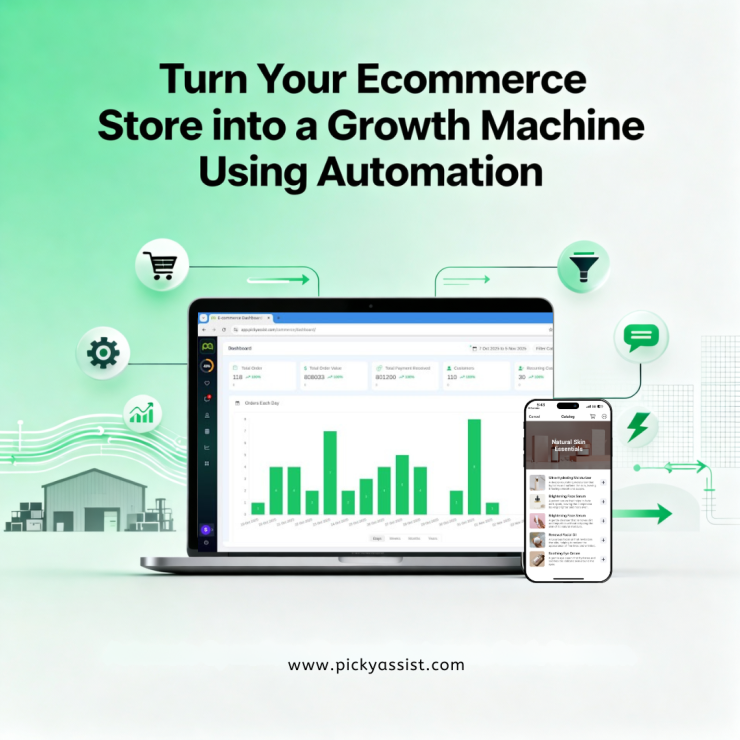
Running an ecommerce business manually no longer scales. As orders increase, customer expectations rise, and competition intensifies, automation becomes essential. That is why learning how to automate your ecommerce business is no longer optional, it is a growth requirement.
In this guide, you will learn what ecommerce automation is, why it matters, which areas to automate first, and which tools deliver the highest ROI. More importantly, you will understand how unified automation platforms like Picky Assist outperform fragmented automation tools.
Let’s begin.
What is Ecommerce Automation?
Ecommerce automation uses software, workflows, and AI to handle repetitive tasks without human effort. Instead of manually managing orders, messages, inventory, and follow-ups, automation systems execute them instantly and accurately.
As a result, your ecommerce business runs faster, leaner, and more profitably.
When you automate your ecommerce business correctly, you:
- Reduce manual work
- Eliminate human errors
- Respond to customers instantly
- Improve conversion rates
- Scale operations without increasing headcount
Why Ecommerce Automation Matters More Than Ever?
Customer behavior has changed. Shoppers now expect instant replies, real-time updates, and personalized experiences. However, manual processes cannot meet these expectations consistently.
Because of this, ecommerce automation delivers a clear advantage.
Here’s why automation matters:
- First, it saves time by eliminating repetitive tasks
- Next, it increases revenue through faster follow-ups
- Then, it improves customer satisfaction with instant responses
- Finally, it enables scalable growth without operational chaos
In short, automation turns your ecommerce store into a system, not a struggle.
How to Automate An E-commerce Business?
To automate your ecommerce business effectively, you must follow a structured approach. Random automation creates confusion, while strategic automation creates growth.
Assess Tasks That Consume Time
Start by identifying tasks your team repeats daily.
For example:
- Answering the same customer questions
- Updating order status manually
- Sending payment reminders
- Tracking inventory in spreadsheets
- Following up on abandoned carts
Once you list these tasks, automation opportunities become obvious.
Choose the Right Ecommerce Automation Tools
Next, select tools that integrate seamlessly with your ecommerce platform.
A modern ecommerce automation stack includes:
- An ecommerce platform (Shopify or WooCommerce)
- A unified CRM and Ecommerce automation platform (Picky Assist)
- Shipping automation tools (ShipStation or Shiprocket)
Most importantly, unified tools outperform individual tools because they reduce data silos.
Create Automation Workflows
Now, build workflows that move data automatically between systems.
For example:
- A new order triggers inventory updates
- A payment triggers order confirmation
- A delayed checkout triggers abandoned cart reminders
- A customer message updates the CRM automatically
As a result, your ecommerce operations stay synchronized in real time.
Test, Monitor, and Optimize
Finally, test every workflow before scaling. After that, monitor performance regularly. Then, optimize flows based on data, not assumptions.
Automation works best when it evolves continuously.
Key Areas to Automate in your Ecommerce Business
To rank higher and scale faster, you must automate the right areas first.
1. Inventory Management Automation
Manual inventory tracking leads to overselling and stockouts. However, automation solves this instantly.
With automation:
- Inventory updates in real time
- Stock syncs across Shopify, WooCommerce, and WhatsApp
- Low-stock alerts trigger automatically
As a result, you never lose sales due to inventory errors.
2. Order Fulfillment & Shipping Automation
Order fulfillment becomes complex as volume grows. Therefore, shipping automation becomes critical.
By integrating Picky Assist with ShipStation, Shiprocket, or EasyShip:
- Orders sync automatically
- Shipping labels generate instantly
- Customers receive real-time tracking updates
Consequently, delivery speed improves and support tickets are reduced.
3. Marketing & Sales Automation
Marketing automation converts traffic into revenue without constant manual effort.
Key ecommerce marketing automations include:
- Abandoned cart recovery
- Automated WhatsApp follow-ups
- Personalized broadcast campaigns
- Product recommendations
When done correctly, automation nurtures leads while you focus on growth.
4. Customer Service Automation
Customer support consumes massive time. However, AI chatbots change everything.
With AI-driven automation:
- Customers receive instant replies 24×7
- FAQs resolve without human intervention
- Conversations route to the right team automatically
As a result, response time drops while satisfaction increases.
5. Data, CRM & Finance Automation
Disconnected data kills efficiency. Therefore, CRM automation is essential.
With automated CRM updates:
- Every chat updates customer profiles
- Purchase history syncs automatically
- Revenue tracking becomes accurate
The clarity improves decision-making across marketing, sales, and operations.
Why Picky Assist is the Best All-in-One Ecommerce Automation Platform?
Individual automation tools exist everywhere. However, unified platforms always win in the long run. Picky Assist stands out because it combines CRM, WhatsApp automation, AI chatbots, workflows, and payments in one ecosystem.
Core Picky Assist Automation Features
Unified Inbox (Teambox)
Your team and customers stay connected through one shared inbox. WhatsApp and Messenger conversations sync seamlessly.
Smart Replies with AI & ML
AI chatbots handle customer queries 24×7. As a result, your business never sleeps.
Conversational Funnel
Picky Assist connects conversations, data, and actions into one unified funnel. Therefore, every interaction drives a measurable outcome.
WhatsApp Catalog Automation
Sell directly on WhatsApp without a mobile app or website using WhatsApp catalogs. Products, orders, and payments automate completely.
Broadcaster V2
Send compliant WhatsApp broadcasts to nurture leads, convert customers, and boost repeat sales.
Connector (3000+ App Integrations)
Connect Shopify, WooCommerce, Shiprocket, ShipStation, Zapier, and more using Connectors without having coding skills. Build multi-step workflows with filters and delays.
WhatsApp Flows
Create app-like experiences inside WhatsApp with no code Whatsapp flows. Collect data, qualify leads, and automate processes instantly.
WhatsApp Payment Automation
Accept payments, confirm orders, and trigger fulfillment automatically with automated payment collection. Send automated reminders if left unpaid. No humans required, just focus on shipping.
No-Code Flow Builder
Build advanced automated AI bots by dragging and connecting blocks using no-code chatbot builder. Zero coding. Full control.
All-in-One CRM
Manage leads, customers, and conversations in one place with Picky Assist CRM. Integrated conversational chatbots will enhance productivity inside this dynamic CRM as it auto capture lead stages during chatbot conversations.
AI Mate
Boost team productivity by 10× with AI-assisted replies, summaries, and task automation, while using and working within the CRM
Other Ecommerce Automation Integrations
To build an ecosystem, integrate these tools:
- Platforms: Shopify, WooCommerce
- Shipping: ShipStation, Shiprocket, EasyShip
- Marketing: Klaviyo, Mailchimp
- Support: Gorgias, Zendesk, Wassenger
- Automation: Zapier
- Unified CRM & Automation: Picky Assist
When these tools work together, your ecommerce business runs like a machine. But individual tools would always create some sort of trouble, so just integrate Picky assist along with a delivery platform and run your E-commerce business confidently, without any other third party tools.
Final Thoughts
Automation does not remove humans. Instead, automation removes friction. When you understand how to automate your ecommerce business correctly, you:
- Scale without chaos
- Sell without delays
- Support without burnout
- Grow without guesswork
Unified solutions like Picky Assist future-proof your ecommerce operations while fragmented tools slow you down. If you want sustainable growth, automation is no longer a choice, it is the foundation.
FAQs on How to Automate Your Ecommerce Business
1. What does it mean to automate an ecommerce business?
Automating an ecommerce business means using software and AI to handle repetitive tasks like order processing, inventory updates, customer support, marketing follow-ups, and shipping.
2. How can I automate my ecommerce business step by step?
You can automate your ecommerce business by first identifying repetitive tasks, then choosing automation tools, creating workflows, and finally testing and optimizing them. For example, you can connect Shopify or WooCommerce with Picky Assist and shipping tools like Shiprocket to automate orders, messages, and fulfillment.
3. What are the best tools to automate an ecommerce business?
The best ecommerce automation tools include Shopify or WooCommerce for the store, Picky Assist for CRM and WhatsApp automation, ShipStation or Shiprocket for shipping. Picky Assist also has a WhatsApp store that is much more affordable than WooCommerce, this is because Unified platforms work better than using multiple disconnected tools.
4. How does WhatsApp automation help ecommerce businesses?
WhatsApp automation helps ecommerce businesses by enabling instant customer replies, abandoned cart reminders, order updates, product catalogs, and payment collection. With tools like Picky Assist, businesses can sell, support, and follow up automatically inside WhatsApp.
5. Can I automate ecommerce customer support with AI?
Yes, you can automate ecommerce customer support using AI chatbots. AI chatbots answer FAQs, track orders, qualify leads, and route conversations automatically. As a result, response time improves and support costs are reduced.
6. Is ecommerce automation suitable for small businesses?
Ecommerce automation works extremely well for small businesses. Automation reduces manual effort, improves efficiency, and allows small teams to compete with larger brands. Tools like no-code automation platforms make setup easy and affordable.
7. How does ecommerce automation increase sales?
Ecommerce automation increases sales by reducing response time, recovering abandoned carts, sending personalized follow-ups, and ensuring smooth order fulfillment. Faster interactions and timely messages improve conversion rates significantly.
8. Can I automate ecommerce payments and order confirmation?
Yes, you can automate ecommerce payments and order confirmation using WhatsApp payment automation. Picky assist lets customers browse products, pay, receive confirmation, and trigger shipping automatically without human involvement.
9. Does ecommerce automation require coding skills?
No, modern ecommerce automation does not require coding. No-code flow builders allow you to create advanced automation by dragging and connecting blocks. This makes automation accessible to non-technical teams.
10. How long does it take to automate an ecommerce business?
Basic ecommerce automation can be set up within a few days. However, advanced automation improves continuously over time as you refine workflows, analyze data, and optimize customer journeys.
11. Is ecommerce automation safe and reliable?
Ecommerce automation is safe and reliable when implemented using trusted platforms. Automated systems reduce human error, maintain consistent processes, and ensure data accuracy across sales, support, and fulfillment.
12. What is the biggest mistake businesses make with ecommerce automation?
The biggest mistake businesses make is using too many disconnected tools. Fragmented automation creates data silos and inefficiencies. Unified solutions always deliver better long-term results. Picky Assist is a reliable automation tool ensuring secured transitions, product browsing, order tracking and delivery integrations.


Add comment