
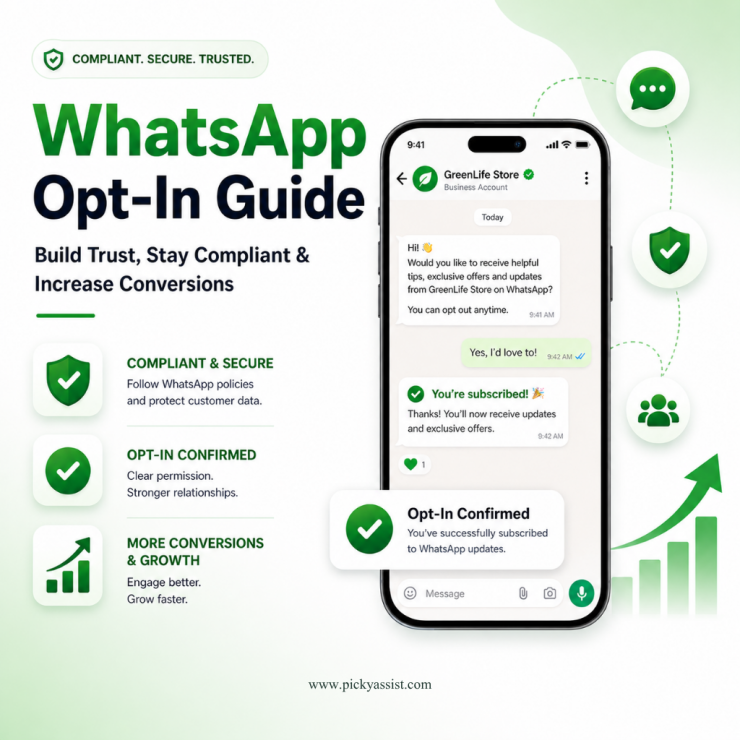
Modern customer communication is no longer about blasting messages. It’s about permission, timing, and relevance. Businesses that understand this are building stronger engagement pipelines, while those that don’t are seeing declining response rates and increasing compliance risks. At the center of this shift lies one critical concept: WhatsApp business opt in.
If you’re planning to use WhatsApp as a serious revenue channel, not just a support tool, understanding opt-in is non-negotiable. More importantly, executing it strategically can directly impact your conversion rates, retention, and customer trust.
This guide breaks down everything decision-makers need to know, from policy clarity to execution frameworks and shows how platforms like Picky Assist turn opt-ins into scalable growth systems.
What is WhatsApp Business Opt In?
A WhatsApp business opt in is a user’s explicit consent to receive messages from your business on WhatsApp.
This consent can be collected through various channels, your website, app, forms, checkout pages, or even offline touchpoints. However, what matters most is clarity and intent.
In simple terms, it means:
- The user knows they are opting in
- They understand what type of messages they’ll receive
- They willingly agree to be contacted on WhatsApp
Without this, you are not just risking low engagement, you are violating platform policies.
Why Opt-In is a Strategic Lever?
Many businesses treat opt-in as a legal checkbox. That’s a mistake.
When executed correctly, opt-in becomes a conversion engine.
1. Higher Engagement Rates
Users who opt in are already interested. This leads to significantly higher open and response rates compared to email or SMS.
2. Better Lead Qualification
Opt-in acts as a natural filter. You’re communicating only with users who are genuinely interested.
3. Reduced Communication Costs
Targeted messaging reduces wasted sends and improves ROI across campaigns.
4. Stronger Customer Trust
Permission-based messaging builds credibility and long-term brand affinity.
Understanding the WhatsApp Opt In Policy
The WhatsApp opt in policy is clear but often misunderstood.
Here are the core principles businesses must follow:
Explicit Consent
Pre-checked boxes or hidden consent mechanisms are not allowed. The user must actively agree.
Clear Value Communication
You must specify:
- What type of messages will be sent
- How frequently
- Why the user should opt in
Easy Opt-Out
Users should be able to unsubscribe easily at any time.
Channel-Specific Consent
Consent for email or SMS does not automatically apply to WhatsApp.
Common Mistakes Businesses Make
Even experienced teams get this wrong. Here are the most frequent issues:
1. Vague Consent Language
“Stay updated” is not enough. Be specific.
2. No Context of Usage
Users need to know if they’ll receive offers, updates, reminders, or support messages.
3. Forcing Opt-In
Bundling WhatsApp consent with mandatory form fields reduces trust and may violate policy.
4. Poor Timing
Asking for opt-in too early in the funnel often results in low acceptance.
Where and How to Collect Opt-In Effectively?
A strong opt-in strategy integrates naturally into your customer journey.
Website Forms
Add opt-in checkboxes during:
- Lead capture forms
- Demo requests
- Newsletter signups
Checkout Pages
Ecommerce brands can collect opt-in during purchase confirmation for:
- Order updates
- Delivery tracking
- Post-purchase engagement
Landing Pages
Use dedicated campaigns with clear incentives like:
- Exclusive offers
- Early access
- Personalized recommendations
Offline Channels
Retail stores, events, and call centers can collect consent via:
- QR codes
- Digital forms
- Assisted signups
WhatsApp Business API Opt In: What Changes at Scale?
When businesses move to the WhatsApp business API opt in model, expectations become stricter, but so do the opportunities.
Key Differences:
- Messaging must follow approved templates
- Opt-in records must be stored and verifiable
- Automation becomes central to execution
This is where many businesses struggle, not with collecting opt-in, but with managing it effectively across systems.
Turning Opt-In Into a Revenue Engine with Picky Assist
Collecting consent is only step one. The real value comes from how you use it.
Picky Assist transforms opt-in into a structured growth system through:
1. Automated Opt-In Capture Across Channels
Whether it’s WhatsApp, Instagram, website, or email, opt-ins are centralized and tracked.
2. Intelligent Segmentation
Not all opt-ins are equal. Picky Assist allows segmentation based on:
- User behavior
- Interaction history
- Funnel stage
3. Conversational Funnels
Instead of static messaging, businesses can create dynamic journeys that:
- Nurture leads
- Qualify prospects
- Drive conversions
4. Compliance-First Messaging
Built-in safeguards ensure every message aligns with WhatsApp policies.
5. Unified CRM + Teambox
All conversations, opt-ins, and interactions are managed in one CRM system connected with a shared inbox, reducing fragmentation and improving team efficiency.
Crafting a High-Converting WhatsApp Opt In Message Template
A well-designed WhatsApp opt in message template can dramatically increase acceptance rates.
Key Elements of a Strong Template:
- Clear value proposition
- Specific message type
- Transparent frequency
- Simple call-to-action
Example:
“Get real-time order updates and exclusive offers directly on WhatsApp. Tick the box to stay connected.”
Advanced Version (High-Intent Funnel):
“Want priority access to new product launches and personalized recommendations on WhatsApp? Opt in now and stay ahead.”
Notice the difference, one informs, the other sells value.
Strategic Use Cases Across Industries
Ecommerce
- Order confirmations
- Abandoned cart recovery
- Personalized product recommendations
Education
- Course updates
- Admission reminders
- Webinar alerts
Healthcare
- Appointment reminders
- Follow-up care instructions
Real Estate
- Property alerts
- Site visit scheduling
- Lead nurturing
Each of these becomes significantly more effective when backed by a strong opt-in strategy.
Measuring the Effectiveness of Your Opt-In Strategy
To optimize performance, track:
- Opt-in conversion rate
- Message open rate
- Response rate
- Drop-off/unsubscribe rate
- Revenue per opted-in user
Picky Assist provides visibility into these metrics, helping businesses continuously refine their approach.
How to Optimize Opt-In for Better Conversions?
Use Contextual Timing
Ask for opt-in when user intent is high, during checkout or after engagement.
Offer Immediate Value
Give users a reason to say yes instantly.
Keep It Frictionless
Avoid long forms or complicated processes.
Test Variations
Experiment with different messaging styles, placements, and incentives.
Final Thoughts
WhatsApp business opt in is not just a technical requirement. It’s a strategic advantage.
Businesses that approach it thoughtfully unlock:
- Higher engagement
- Better customer relationships
- More predictable conversions
However, the real differentiation lies in execution. Without the right systems, opt-in becomes fragmented and underutilized.
That’s where platforms like Picky Assist step in, bridging the gap between consent and conversion through automation, intelligence, and seamless integration.
FAQs on WhatsApp Business Opt In
1. What is the correct way to collect WhatsApp business opt in?
The correct method involves explicit user consent with clear communication about the type of messages they will receive and how often.
2. Is WhatsApp opt-in mandatory for all businesses?
Yes, any business using WhatsApp for proactive messaging must obtain user consent before sending messages.
3. Can I use email consent as WhatsApp opt in?
No, consent must be channel-specific. Users must explicitly agree to receive messages on WhatsApp.
4. What happens if I send messages without opt-in?
This can lead to account restrictions, lower message delivery rates, or even suspension.
5. How do I store opt-in records?
Businesses should maintain verifiable records of consent, including time, source, and method of opt-in.
6. What is the difference between regular opt-in and WhatsApp business API opt in?
API-based opt-in requires stricter compliance, message templates, and proper documentation for scalability.
7. Can users opt out after opting in?
Yes, users must have an easy and clear way to unsubscribe at any time.
8. How can I improve opt-in conversion rates?
Focus on timing, clarity, and value-driven messaging. Offering immediate benefits significantly improves acceptance rates.
Add comment