
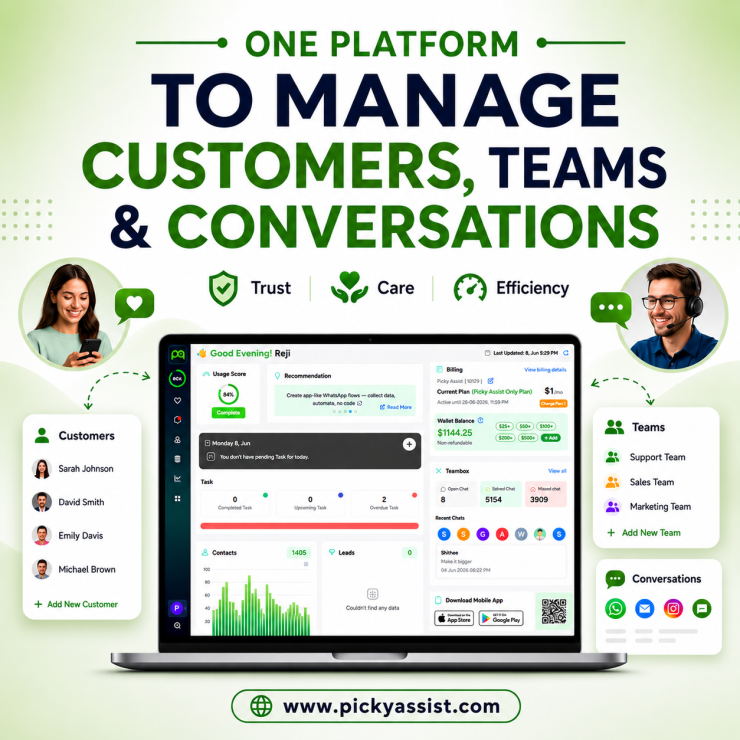
Customers expect fast, personalized communication across channels, while teams need visibility into customer interactions and follow-ups. Yet many businesses still rely on disconnected tools, leading to delays, missed opportunities, inconsistent customer experiences, and operational inefficiencies. As a result, businesses are increasingly searching for the best communication platforms for business, solutions that centralize communication, improve collaboration, automate engagement, and support long-term growth.
In this guide, we’ll explore what modern business communication platforms should offer, key evaluation criteria, emerging trends, and how platforms like Picky Assist help organizations create more connected customer engagement experiences.
What are Business Communication Platforms?
Business communication platforms are systems designed to help organizations manage conversations, interactions, and information exchange across customers, teams, and business processes. Historically, communication platforms focused primarily on internal collaboration through messaging and video conferencing. Today, however, communication plays a much broader role. Modern communication platforms for business increasingly combine:
- Customer communication
- Team collaboration
- CRM integration
- Workflow automation
- Customer engagement management
- Communication analytics
The goal is not simply to send messages but to create structured communication processes that improve business outcomes.
Why Do Businesses Need More Than Traditional Communication Tools?
Many organizations start with basic communication channels. Examples include:
- WhatsApp Business App
- Phone calls
- Team chat applications
These tools work well initially. However, as customer volumes increase, limitations become obvious. Common challenges include:
Customer Data is Scattered
Customer information often exists across multiple systems with no centralized view.
Conversations Become Difficult to Track
Teams struggle to understand previous interactions and customer history.
Follow-Ups are Inconsistent
Without structured workflows, opportunities can be missed.
Team Collaboration Suffers
Departments operate independently without shared visibility.
Reporting is Limited
Businesses lack insight into communication performance and customer engagement trends. The best business communication platforms address these challenges by connecting communication with business processes.
What Makes the Best Communication Platforms for Business?
Choosing the right platform requires looking beyond messaging features. The most effective solutions support customer engagement, operational efficiency, and business growth.
Multi-Channel Communication
Customers communicate through different channels. A platform should support channels such as:
- Website chat
- Social messaging platforms
Businesses need flexibility to engage customers where they are most active from a single shared inbox.
Centralized Customer Visibility
Communication becomes significantly more valuable when connected to customer data. Teams should be able to view:
- Customer profiles
- Conversation history
- Lead status
- Previous interactions
This creates context for every customer interaction.
Automation Capabilities
Modern communication systems should reduce manual work. Automation can support:
- Lead assignment
- Customer follow-ups
- Appointment reminders
- Customer onboarding
- Workflow execution
This improves efficiency while maintaining consistency.
Scalability
The platform should support future business growth without creating operational bottlenecks.
The Evolution of Communication Platforms
Communication technology has evolved significantly over the last decade. Businesses are moving through several stages:
Basic Communication
Email and phone-based communication dominate interactions.
Multi-Channel Communication
Businesses adopt messaging apps, live chat, and social platforms.
Unified Communication
Communication channels become centralized.
Intelligent Communication
Automation, CRM integration, and AI-driven workflows support customer engagement.
The most successful organizations are increasingly investing in intelligent communication ecosystems rather than isolated communication tools. Picky Assist is such an AI conversational, CRM integrated and multichannel connected platform that can respond to enquiries with AI chatbots.
Unified Communication Platforms vs Standalone Communication Tools
Many businesses encounter the term unified communication platform during their software evaluation process. Understanding the difference is important.
Standalone Tools
Standalone tools focus on a single communication function. Examples include:
- Email platforms
- Messaging applications
- Video conferencing tools
While useful, they often operate independently.
Unified Communication Platforms
A unified communication platform brings multiple communication channels into a centralized environment. Benefits include:
- Better visibility
- Improved collaboration
- Centralized customer interactions
- Consistent communication experiences
- Operational efficiency
This approach is particularly valuable for customer-facing businesses.
Why should Customer Communication be considered as an important Business Process?
Communication is no longer just a support function. It directly impacts:
- Lead generation
- Customer acquisition
- Customer retention
- Revenue growth
- Brand experience
Businesses that manage communication strategically often achieve stronger customer relationships. This shift is why communication systems increasingly overlap with CRM platforms and customer engagement tools.
Role of AI Automation in Modern Communication Platforms
Artificial intelligence is transforming how businesses communicate. Rather than simply routing messages, AI automation helps businesses manage customer interactions more efficiently. Examples include:
- Instant responses
- Lead qualification
- Customer routing
- Automated follow-ups
- Customer segmentation
- Workflow triggering
AI helps organizations scale communication without sacrificing responsiveness.
Conversational AI Automation and Customer Expectations
Customers increasingly prefer conversational experiences. Rather than filling out forms or waiting for email replies, they want immediate answers through messaging channels. Conversational AI automation supports this shift. Businesses can automate interactions that:
- Answer frequently asked questions
- Collect customer information
- Schedule appointments
- Share product information
- Guide customers through workflows
This creates a more engaging customer experience while reducing operational workload.
How AI CRM Automation Connects Communication and Customer Management?
Communication becomes far more valuable when connected to customer data. AI CRM automation helps businesses combine:
- Customer records
- Communication history
- Workflow automation
- Lead management
- Customer engagement tracking
For example:
A customer sends a WhatsApp enquiry. The platform can automatically:
- Create a customer profile
- Capture interaction history
- Qualify the lead
- Assign ownership
- Trigger follow-up workflows
This creates a more structured customer journey.
Why Do Small Businesses Need Connected Communication Systems?
Growing businesses often face communication challenges first. As enquiry volumes increase, manual communication processes become difficult to manage. Organizations looking for client management software for small business frequently discover that communication management is equally important. A connected platform helps small businesses:
- Organize customer interactions
- Improve follow-up consistency
- Reduce manual work
- Track customer journeys
- Scale customer engagement
This allows smaller teams to operate more efficiently.
How Picky Assist Helps Businesses Manage Customer Communication?
Picky Assist helps businesses centralize customer communication, automate engagement workflows, and improve customer relationship management. The platform combines communication tools with CRM functionality and automation capabilities.
WhatsApp Automation
Automate customer conversations, notifications, follow-ups, and engagement workflows.
Centralized CRM
Manage customer information, interaction history, and lead records within a shared inbox.
No-Code Chatbot Builder
Create conversational workflows without extensive technical resources with no-code builder.
Customer Segmentation
Organize audiences for more targeted communication.
Broadcast Campaigns
Deliver personalized communication to selected customer groups with automated broadcaster.
Workflow Automation
Automate repetitive business processes connected to customer engagement.
Team Collaboration
Enable teams to manage customer conversations with greater visibility and coordination. These capabilities help businesses create more efficient communication systems while maintaining stronger customer relationships.
How to Evaluate the Right Communication Platform for Your Business?
Before selecting a solution, businesses should ask:
Which channels do customers prefer?
Communication platforms should align with customer behavior.
Do teams need shared visibility?
Collaboration requirements influence platform selection.
Is automation important?
Growing businesses often benefit significantly from automation capabilities.
Does communication need CRM integration?
Connecting conversations to customer records improves visibility and customer experience.
Can the platform support future growth?
Scalability should always be part of the evaluation process.
The best communication platform is not necessarily the one with the most features, it is the one that aligns with business objectives and customer engagement requirements.
Conclusion
Finding the best communication platforms for business requires looking beyond messaging functionality. Modern businesses need solutions that connect customer communication, workflow automation, customer relationship management, and team collaboration into a unified experience.
As communication becomes increasingly central to customer acquisition, engagement, and retention, organizations need systems that support both operational efficiency and customer experience.
Picky Assist helps businesses achieve this by combining WhatsApp automation, CRM functionality, conversational workflows, customer segmentation, and automation tools within a centralized platform designed to support modern customer engagement strategies.
FAQs on Best Communication Platforms for Business
1. What are the best communication platforms for business?
The best communication platforms help businesses centralize customer interactions, support multiple communication channels, automate workflows, and integrate with customer management systems.
2. Why are communication platforms important for business growth?
Effective communication platforms improve customer engagement, response times, collaboration, lead management, and operational efficiency, all of which contribute to business growth.
3. What is a unified communication platform?
A unified communication platform combines multiple communication channels into a single environment, helping businesses manage interactions more efficiently.
4. How does AI automation improve business communication?
AI automation supports instant responses, lead qualification, workflow execution, customer routing, and automated follow-ups, helping businesses scale communication more effectively.
5. What is conversational AI automation?
Conversational AI automation enables businesses to automate customer interactions through messaging channels while maintaining a natural conversational experience.
6. How does AI CRM automation help businesses?
AI CRM automation connects customer communication with customer data, enabling automated lead management, segmentation, follow-ups, and customer journey tracking.
7. How do communication platforms differ from CPaaS companies?
Communication platforms provide ready-to-use business solutions, while CPaaS companies provide communication infrastructure and APIs that developers use to build custom communication experiences.
8. How does Picky Assist support business communication management?
Picky Assist helps businesses centralize customer communication, automate WhatsApp engagement, manage customer relationships, create chatbot workflows, and streamline customer interactions through a unified platform.

Add comment