
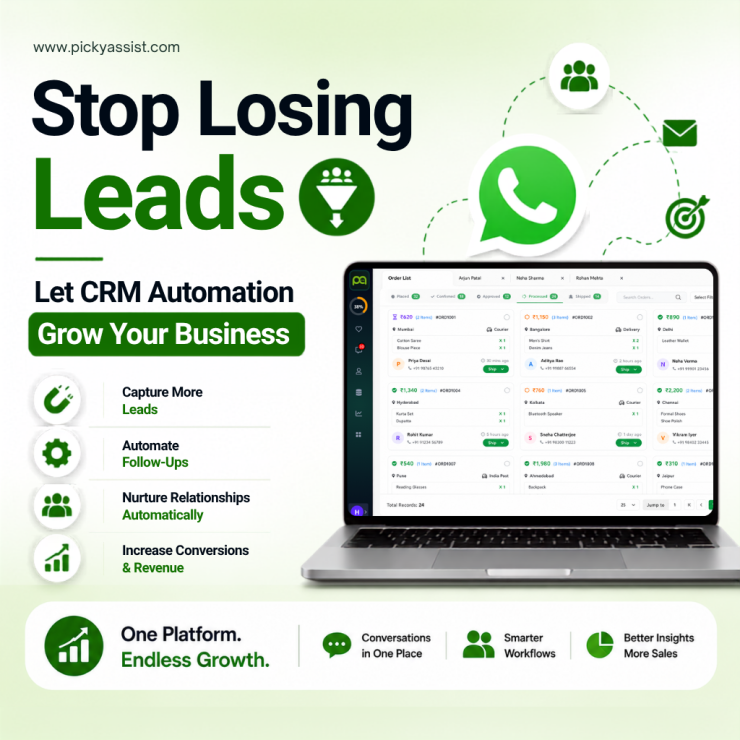
Many organizations still rely on disconnected tools to manage customer relationships and marketing campaigns. Sales teams work inside a CRM, marketing teams operate separate campaign platforms, and customer interactions remain fragmented across channels. The result is often lost leads, inconsistent follow-ups, poor visibility, and lower conversion rates. This is where a CRM and marketing automation platform becomes valuable. By combining customer relationship management with automated communication workflows, businesses can centralize customer data, improve lead management, automate engagement, and create more personalized customer experiences at scale.
In this guide, we’ll explore how a CRM and marketing automation platform works, why businesses are adopting it, key features to evaluate, and how solutions like Picky Assist help organizations streamline customer engagement through automation and conversational channels.
What is a CRM and Marketing Automation Platform?
A CRM and marketing automation platform combines two essential business functions:
- Customer Relationship Management (CRM)
- Automated marketing and communication workflows
The CRM component stores and organizes customer information, interactions, sales activities, and lifecycle data. The marketing automation component helps businesses automatically engage prospects and customers through scheduled, triggered, or behavior-based communication.
Instead of managing customer data in one system and campaigns in another, businesses can operate from a centralized environment where customer actions trigger automated marketing and sales workflows.
For example:
- A website enquiry automatically creates a lead.
- The lead is assigned to a sales representative.
- An automated WhatsApp message is sent instantly.
- Follow-up reminders are scheduled automatically.
- Customer engagement is tracked within the CRM.
- Sales teams receive visibility into every interaction.
This creates a seamless customer journey from initial enquiry to conversion and retention.
Why are Businesses Moving Toward Integrated Automation?
Businesses no longer compete solely on products or pricing. Customer experience increasingly influences buying decisions. When customer data is scattered across spreadsheets, messaging apps, emails, and multiple software platforms, teams struggle to deliver consistent experiences. Common challenges include:
- Delayed responses to enquiries
- Missed follow-ups
- Duplicate customer records
- Poor lead qualification
- Lack of campaign visibility
- Inefficient team collaboration
- Limited customer journey tracking
A modern CRM and marketing automation platform helps solve these issues by creating a unified operational framework for customer engagement. As a result, businesses can respond faster, nurture leads more effectively, and improve conversion opportunities without increasing manual workload.
Components of a CRM and Marketing Automation Platform
Centralized Customer Database
Every customer interaction becomes part of a single customer profile.
This may include:
- Contact information
- Communication history
- Lead source
- Purchase history
- Notes and activities
- Campaign engagement
- Support interactions
Having a centralized customer view allows teams to make informed decisions and deliver more relevant communications.
Automated Lead Capture
Lead capture should happen automatically whenever a prospect interacts with your business.
Sources may include:
- Website forms
- WhatsApp enquiries
- Social media campaigns
- Email campaigns
- Landing pages
- Referral programs
Instead of manually transferring information, leads are automatically stored inside the CRM.
Customer Segmentation
Not every lead should receive the same communication. Businesses can group customers based on:
- Demographics
- Interests
- Buying behavior
- Engagement level
- Purchase history
- Geographic location
Segmentation enables more targeted and relevant marketing efforts.
Workflow Automation
Workflow automation reduces repetitive manual tasks. Examples include:
- Lead assignment
- Follow-up scheduling
- Customer onboarding
- Appointment reminders
- Sales notifications
- Customer re-engagement campaigns
Automation ensures consistency while reducing administrative overhead.
How CRM and Marketing Automation Improve Lead Nurturing?
Many leads are not ready to buy immediately. Without a structured nurturing process, businesses often lose potential opportunities. A CRM and marketing automation platform helps maintain engagement throughout the buying journey. For example: A prospect downloads a travel package brochure. The platform can automatically:
- Create a lead profile.
- Send a welcome message.
- Share relevant travel packages.
- Schedule follow-up communication.
- Alert a sales representative when engagement increases.
This creates a more organized and personalized lead nurturing process. Over time, businesses can build stronger relationships while improving conversion potential.
The Role of Conversational Channels in Modern CRM Automation
Traditional email-only automation is no longer sufficient. Customers increasingly prefer conversational channels such as:
- Facebook Messenger
- Website chat
These channels provide faster and more interactive communication experiences. A modern CRM automation software solution should support conversational engagement alongside traditional marketing channels. Businesses can:
- Answer enquiries instantly
- Automate FAQs
- Qualify leads
- Schedule appointments
- Share product information
- Collect customer data
All interactions can be synchronized with the CRM for complete visibility.
Why WhatsApp Has Become a Critical Automation Channel?
WhatsApp has evolved from a messaging app into a significant business communication platform. Customers often prefer WhatsApp because it offers:
- Immediate communication
- Higher engagement rates
- Familiar user experience
- Real-time conversations
Businesses can use WhatsApp automation to:
- Respond instantly
- Send updates
- Nurture leads
- Recover abandoned enquiries
- Deliver post-purchase support
For organizations operating in service industries, healthcare, education, travel, real estate, finance, and ecommerce, WhatsApp can become a major customer engagement channel.
What Makes the Best CRM Automation Software?
Choosing the best CRM automation software requires evaluating more than just CRM functionality. Consider the following factors:
Multi-Channel Communication
The platform should support communication across:
- Website chat
- Social media channels
Automation Flexibility
Businesses should be able to build workflows without extensive technical expertise.
Lead Management
Strong lead management capabilities help organize, prioritize, and track opportunities.
Team Collaboration
Sales, marketing, and support teams should work from a shared inbox.
Reporting and Analytics
Visibility into campaign performance and customer engagement is essential for continuous improvement.
Integration Capabilities
The platform should connect with existing business tools and workflows.
CRM Automation Tools vs Traditional CRM Systems
Many businesses already use CRM software. However, traditional CRM systems often focus primarily on record management. Modern CRM automation tools extend functionality by enabling action. Traditional CRM:
- Stores customer information
- Tracks sales activities
- Manages contact records
CRM automation:
- Automates communication
- Triggers workflows
- Nurtures leads automatically
- Reduces manual intervention
- Improves customer engagement
The difference lies in turning customer data into automated business processes.
How Picky Assist Helps Businesses Automate Customer Engagement?
Picky Assist combines CRM capabilities with communication automation to help businesses manage customer interactions more efficiently. The platform enables organizations to centralize customer information while automating engagement across conversational channels. Key capabilities include:
Unified CRM Management
Businesses can organize leads, contacts, and customer interactions within a centralized environment.
WhatsApp Automation
Automate customer conversations, lead qualification, support workflows, and follow-ups through WhatsApp.
No-Code Chatbot Builder
Create automated conversational workflows without extensive development resources.
Customer Segmentation
Group audiences based on business requirements and engagement behavior.
Broadcast Campaigns
Send personalized communications to targeted customer segments.
Workflow Automation
Automate repetitive processes across customer acquisition, nurturing, and support activities.
Team Collaboration
Enable teams to manage customer interactions through a shared workspace. By connecting CRM functionality with conversational automation, Picky Assist helps businesses create more efficient customer engagement workflows.
Industries That Benefit From CRM and Marketing Automation
Travel Agencies
Automate enquiry management, package recommendations, follow-ups, and customer communications.
Real Estate
Capture property enquiries, nurture leads, schedule site visits, and track opportunities.
Education
Manage student enquiries, admissions communication, and application follow-ups.
Healthcare
Handle appointment scheduling, reminders, and patient communication workflows.
Ecommerce
Automate customer engagement, order updates, and post-purchase communication.
Financial Services
Improve lead qualification, consultation scheduling, and customer relationship management.
How to Choose the Right CRM and Marketing Automation Platform?
Before selecting a platform, evaluate your business requirements.
Ask:
- Which communication channels do customers prefer?
- How many leads are generated monthly?
- What follow-up processes are currently manual?
- Which workflows consume the most staff time?
- Do teams need shared visibility into customer interactions?
- Is conversational automation important for your business?
The right platform should align with operational needs rather than simply offering the longest feature list. Focus on solving actual business challenges.
Conclusion
Managing customer relationships and marketing activities through disconnected systems creates inefficiencies that limit growth. A CRM and marketing automation platform helps businesses centralize customer data, automate engagement, improve lead nurturing, and streamline communication across multiple channels.
Rather than relying on manual processes, businesses can create structured customer journeys that improve responsiveness, consistency, and operational efficiency. For organizations looking to combine CRM functionality with conversational engagement, automation workflows, and WhatsApp-driven customer communication, Picky Assist provides a practical solution designed to help businesses manage and scale customer interactions more effectively.
FAQs on CRM and Marketing Automation Platform
1. What is a CRM and marketing automation platform?
A CRM and marketing automation platform combines customer relationship management with automated marketing and communication workflows. It helps businesses manage customer data, automate engagement, nurture leads, and track customer interactions from a centralized system.
2. How does CRM and marketing automation improve lead conversion?
Automation ensures that leads receive timely follow-ups, personalized communication, and relevant information throughout the customer journey. This reduces missed opportunities and improves engagement, which can contribute to higher conversion rates.
3. What is the difference between CRM software and CRM automation software?
Traditional CRM software primarily stores and manages customer information. CRM automation software extends these capabilities by automating tasks such as lead assignment, follow-ups, customer nurturing, reminders, and communication workflows.
4. Why is WhatsApp important in modern CRM automation?
WhatsApp enables businesses to communicate with customers through a channel they frequently use. Automated WhatsApp workflows can support lead qualification, customer support, appointment reminders, updates, and personalized engagement.
5. Which industries benefit most from CRM automation tools?
Industries such as travel, real estate, healthcare, education, ecommerce, financial services, and professional services often benefit significantly because they rely on ongoing customer engagement and lead management.
6. What features should I look for in the best CRM automation software?
Key features include lead management, workflow automation, customer segmentation, multi-channel communication, reporting, analytics, integration capabilities, team collaboration tools, and conversational automation support.
7. Can small businesses use CRM and marketing automation platforms?
Yes. Small businesses can use automation to reduce manual work, improve customer communication, organize leads, and scale operations without significantly increasing staffing requirements.
8. How does Picky Assist support CRM and marketing automation?
Picky Assist combines CRM management, WhatsApp automation, chatbot workflows, customer segmentation, broadcast campaigns, workflow automation, and team collaboration features to help businesses manage customer engagement from a centralized platform.
Add comment