
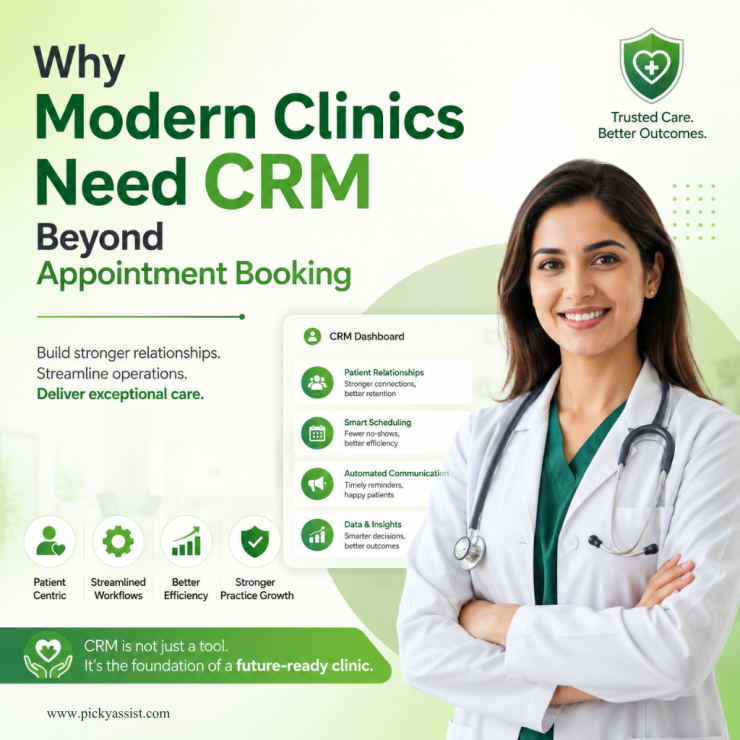
Healthcare businesses now compete on patient experience as much as medical expertise. Slow responses, missed follow-ups, and scattered communication can affect bookings and retention, making a modern CRM for clinic management essential. A clinic CRM has evolved into a patient engagement and communication ecosystem that helps clinics streamline inquiries, automate workflows, improve patient experiences, and increase operational efficiency without overwhelming front-desk teams.
For clinics handling growing patient inquiries across WhatsApp, Instagram, website forms, email, and calls, platforms like Picky Assist help centralize communication while automating repetitive engagement tasks that often consume staff time.
What is a CRM for Clinic Management?
A CRM for clinic management is a system designed to organize, track, automate, and manage patient communication and engagement across different stages of the healthcare journey.
Unlike generic CRM tools built mainly for sales teams, a healthcare-focused CRM helps clinics manage:
- Patient inquiries
- Appointment follow-ups
- Lead tracking
- Consultation reminders
- Multi-channel communication
- Patient engagement workflows
- Internal coordination
- Retention campaigns
- Feedback collection
The goal is not simply storing contact details. The real value comes from creating faster, more responsive, and more organized patient experiences.
Why Are Clinics Moving Beyond Traditional Appointment Management?
Many clinics already use booking software. However, appointment scheduling alone does not solve communication inefficiencies. Most patient drop-offs happen before or after appointments because of:
- Delayed responses to inquiries
- Missed follow-ups
- Poor lead tracking
- Lack of automated reminders
- Scattered communication across platforms
- Inconsistent patient engagement
- No centralized conversation history
This is especially common in:
- Dermatology clinics
- Dental clinics
- Cosmetic clinics
- Wellness centers
- Physiotherapy clinics
- Multi-specialty healthcare practices
As patient expectations become increasingly digital-first, clinics require systems that combine communication, automation, and relationship management in one place. That is where a CRM system for clinic workflows becomes strategically important.
How a CRM Improves Patient Experience?
Patient experience has become a major differentiator in healthcare. Even highly skilled clinics can lose patients if communication feels slow, inconsistent, or disconnected. A modern CRM for medical clinics improves patient experience by making interactions:
- Faster
- personalized
- More organized
- Accessible
- More consistent
Faster Response Times
Patients increasingly expect immediate responses, especially on WhatsApp and social media. Automated acknowledgments and chatbot-based qualification flows help clinics respond instantly even outside working hours. This reduces lead leakage significantly.
Personalized Communication
Patients prefer communication that feels relevant rather than generic. CRM systems help clinics personalize:
- Follow-up messages
- Consultation reminders
- Treatment recommendations
- Educational content
- Re-engagement campaigns
Personalization improves both trust and patient retention.
Better Continuity Across Teams
Without centralized communication, patients often repeat information to multiple staff members. A unified CRM ensures conversation history remains visible across teams, improving continuity and reducing frustration.
Why WhatsApp Integration Matters for Healthcare Communication?
WhatsApp has become one of the most preferred communication channels for patients. Many clinics already receive inquiries through WhatsApp daily. However, manually managing these conversations becomes difficult as inquiry volume grows. A clinic CRM integrated with WhatsApp helps:
- Centralize conversations
- Automate responses
- Track inquiries
- Assign chats to teams
- Send reminders
- Improve response speed
Picky Assist enables WhatsApp automation and conversational workflows that help clinics manage patient engagement more efficiently without relying entirely on manual messaging.
Common Problems Clinics Face Without a CRM
Missed Follow-Ups
Without automated workflows, many inquiries never receive consistent follow-up communication.
This leads to:
- Lost consultations
- Lower conversion rates
- Reduced patient retention
Scattered Communication
Patient conversations spread across:
- Calls
- Spreadsheets
This creates operational confusion and delays.
Inconsistent Patient Experience
Different staff members may communicate differently, leading to inconsistent experiences that affect trust.
Limited Visibility Into Lead Conversion
Without centralized tracking, clinics struggle to identify:
- Which channels generate the best leads
- Which campaigns convert
- Where patients drop off
- Which follow-ups work best
CRM reporting helps improve operational decision-making.
What Makes Picky Assist Relevant for Clinics?
Picky Assist is designed around conversational engagement and workflow automation, making it relevant for healthcare businesses that manage patient communication across multiple channels.
Key capabilities include:
Centralized Communication
Manage WhatsApp, Instagram, email, and other channels in one place through a unified team inbox.
Chatbot Automation
Automate patient inquiry handling, appointment booking, qualification flows, and engagement workflows.
Broadcast Messaging
Send personalized automated updates, reminders, educational content, and promotional campaigns at scale.
Workflow Automation
Automate repetitive operational tasks with WhatsApp flows. No more additional hire or time wasted on tasks including:
- Lead assignments
- Follow-ups
- Reminder sequences
- Engagement workflows
CRM and Team Collaboration
Track patient interactions while improving coordination between support, consultation, and front-desk teams. For clinics looking to improve communication efficiency without adopting overly complex enterprise software, Picky Assist offers a more conversational and automation-focused approach.
How to Choose the Right CRM Software for Clinic Operations?
Choosing the right CRM depends on operational priorities. Here are key evaluation factors:
Communication Capabilities
Does the platform support:
- Website chat
- Team collaboration
Automation Flexibility
Can workflows be customized for:
- Consultations
- Follow-ups
- Patient reminders
- Re-engagement campaigns
Ease of Use
Healthcare teams require systems that are easy to adopt without extensive technical training.
Scalability
The CRM should support future growth as patient inquiries and communication volume increase.
Reporting and Visibility
Analytics help clinics understand:
- Response times
- Lead conversion rates
- Campaign performance
- Patient engagement trends
Conclusion
A modern CRM for clinic operations is no longer just a software upgrade. It is becoming a core operational requirement for clinics that want to improve patient engagement, streamline communication, and scale sustainably. As healthcare interactions continue moving toward messaging platforms and digital-first communication, clinics require systems that go beyond appointment scheduling alone.
From lead management and automated reminders to conversational workflows and multi-channel engagement, CRM platforms help clinics create more organized and responsive patient experiences. For healthcare businesses looking to centralize communication and automate patient engagement workflows, Picky Assist provides an automation-focused CRM ecosystem designed around conversational communication and operational efficiency.
FAQs on CRM for Clinic Management
1. What is a CRM for clinic management?
A CRM for clinic management is a system that helps clinics manage patient communication, inquiries, follow-ups, reminders, and engagement workflows from a centralized platform.
2. Why do clinics need CRM software?
Clinics use CRM software to improve patient communication, reduce missed follow-ups, automate repetitive tasks, centralize inquiries, and improve operational efficiency.
3. How does a CRM improve patient retention?
CRM systems improve retention by enabling personalized communication, automated reminders, follow-up workflows, and consistent patient engagement across different communication channels.
4. Is WhatsApp integration important in a clinic CRM?
Yes. Many patients prefer communicating through WhatsApp. CRM platforms with WhatsApp integration help clinics automate responses, manage conversations efficiently, and improve response times.
5. Can a CRM automate appointment reminders?
Yes. Most modern clinic CRM systems can automate reminders through WhatsApp, SMS, or email to reduce missed appointments and improve scheduling efficiency.
6. How can clinics reduce missed patient inquiries?
Clinics can reduce missed inquiries by using centralized CRM platforms that capture leads automatically, organize conversations, assign staff responsibilities, and automate follow-up workflows.
7. What should clinics look for in CRM software?
Clinics should evaluate communication capabilities, automation features, ease of use, scalability, reporting, and integration support before choosing a CRM solution.
Add comment