
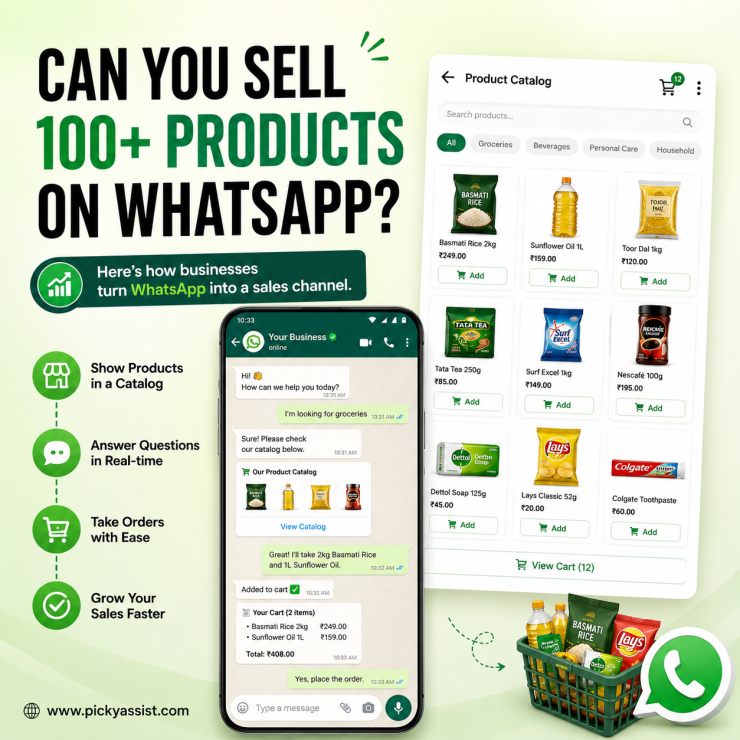
A common pattern in WhatsApp commerce is simple: a customer asks for a product, the business sends photos, the customer asks for the price, then the conversation moves back and forth until someone finally confirms the order. That works for a few customers. It becomes inefficient when dozens or hundreds of customers are shopping simultaneously. WhatsApp selling turns WhatsApp into a sales channel where businesses can display products, answer questions, recommend items, collect orders and follow up with customers in the same conversation. For supermarkets, hypermarkets, boutiques and businesses selling customized products, the WhatsApp catalog can become the starting point for the entire buying journey.
What is WhatsApp Selling?
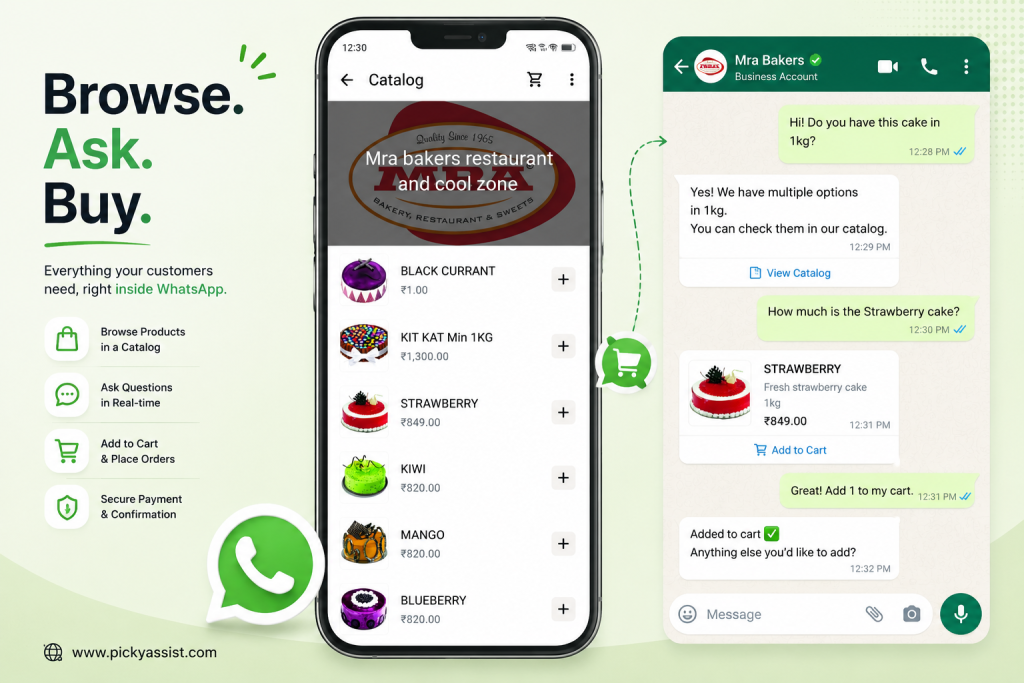
WhatsApp selling is the process of using WhatsApp to present products and services, communicate with customers and complete sales conversations.
Instead of sending customers to a separate website, a business can showcase products through a WhatsApp Business catalog and let customers interact with the business directly. For example, a boutique can display dresses with product images, prices and descriptions. A supermarket can showcase grocery products. A customized-gift business can show available designs and collect customer requirements through chat.
The important part is that the catalog is not the entire sales process. The conversation around the product is what helps convert interest into an order.
How Selling on WhatsApp Business Works?
A practical WhatsApp business sales journey can look like this:
Product discovery → Catalog → Product questions → Recommendation → Cart/order → Payment → Confirmation → Follow-up
Consider a supermarket customer asking:
“Do you have this in a 2 kg pack?”
Instead of sending the customer to another channel, the business can answer inside WhatsApp, show the relevant product and continue toward the order.
For customized products, the conversation can be even more important. A customer may need to provide a name, preferred color, size, design or delivery date before the business can confirm the purchase.
This makes selling through WhatsApp particularly useful for products where customers need assistance before buying.
WhatsApp Catalog vs Sending Product Photos Manually
| Manual Product Selling | WhatsApp Catalog Selling |
|---|---|
| Send individual photos | Maintain structured product listings |
| Repeat prices manually | Display product information consistently |
| Difficult to manage many products | Organize products in a catalog |
| Customers ask for every detail | Key product information is available upfront |
| Sales depend heavily on staff | Automation can handle repetitive interactions |
A catalog does not eliminate salespeople. It reduces the repetitive work surrounding product discovery.
Which Can Sell Through WhatsApp?
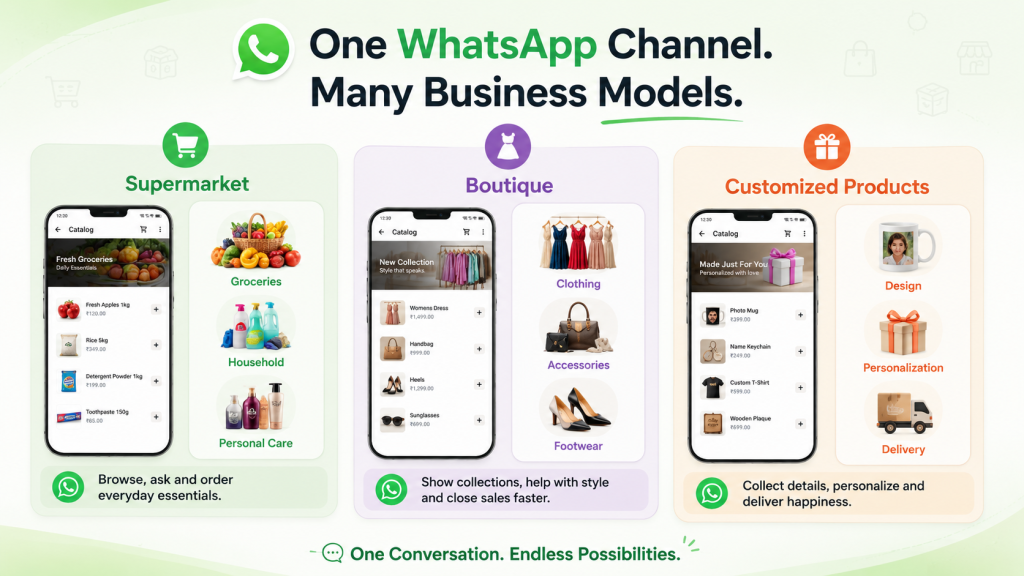
WhatsApp selling works particularly well when customers already prefer conversational purchasing.
Supermarkets and hypermarkets
Businesses can showcase groceries, household products, personal-care items and other frequently purchased products.
Customers can browse products and ask questions before placing an order.
Boutiques and fashion retailers
Boutiques can use catalogs to display clothing, accessories, footwear and collections.
Customers may still need help with size, color, availability or styling, making WhatsApp useful for assisted selling.
Customized product businesses
This is where conversational selling becomes especially valuable.
A customer buying a personalized gift may need to discuss:
- Product design
- Custom text
- Size or color
- Quantity
- Delivery requirements
- Personalization details
The catalog creates product interest; the conversation captures the requirements.
How to Improve WhatsApp Business Sales?
The biggest mistake businesses make when selling through WhatsApp is treating every customer conversation as a manual process.
Start by identifying repetitive questions around your best-selling products.
If customers repeatedly ask “Is this available?”, “What sizes do you have?”, or “How much is delivery?”, those interactions are candidates for automation.
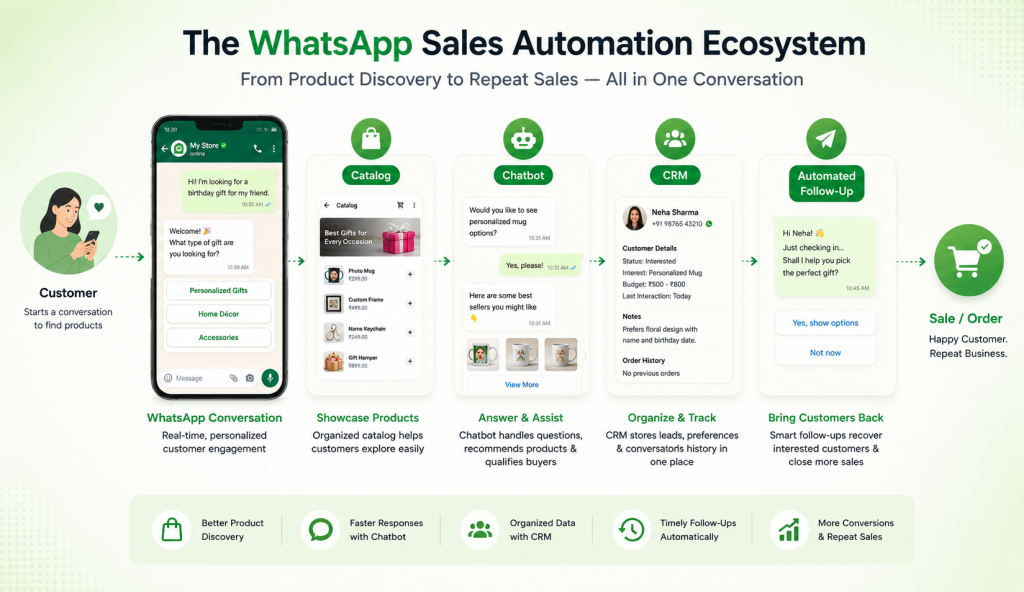
A practical setup can combine:
Catalog + WhatsApp chatbot + CRM + automated follow-ups
The catalog handles product discovery. A chatbot can answer predictable questions. A CRM can organize customer and order information. Automated follow-ups can bring customers back when they showed interest but did not complete the purchase.
Picky Assist brings these capabilities together for businesses that want to sell through WhatsApp while managing customer conversations and sales activity from the same platform.
Common WhatsApp Selling Mistakes
Sending too many products
Do not overwhelm customers with an entire catalog when they have shown interest in one category. Narrow the conversation and recommend relevant products.
Treating every message as a broadcast
Selling is not simply sending promotional messages to a large contact list. Product relevance, customer consent and appropriate WhatsApp messaging practices matter.
Automating everything
A customer asking for a simple price does not necessarily need an agent. A customer requesting a complex customization probably does.
The strongest setup knows when to automate and when to hand the conversation to a person.
Not following up
A customer who asks about a product but does not purchase is not necessarily a lost lead. With appropriate consent and messaging practices, businesses can build structured follow-up journeys rather than relying on employees to remember every conversation.
Final Takeaway
WhatsApp selling works best when the catalog and conversation work together. Products attract attention, while messaging helps customers evaluate, customize and purchase them. For businesses operating heavily through WhatsApp, the opportunity is not simply to show products. It is to build a connected sales journey where customers can discover, ask, decide and buy without leaving the conversation.
Frequently Asked Questions About WhatsApp Selling
Yes. Businesses can use WhatsApp catalogs, product conversations and supported commerce capabilities to showcase products and manage customer interactions around purchases.
A supermarket can organize products in a WhatsApp catalog, answer availability and pricing questions, help customers select products and manage orders through WhatsApp.
Yes. Customized products often require conversation before purchase. WhatsApp allows businesses to collect specifications such as size, color, design and personalization details directly from customers.
Yes. Businesses can automate repetitive product questions, customer qualification, follow-ups and other parts of the sales journey while routing complex conversations to human agents.
Yes. A WhatsApp catalog allows businesses to present products with relevant information so customers can browse offerings within WhatsApp before continuing the conversation.
Yes. WhatsApp can be particularly practical for businesses that already receive customer enquiries and orders through chat. Automation becomes increasingly useful as conversation volume grows.

Add comment