
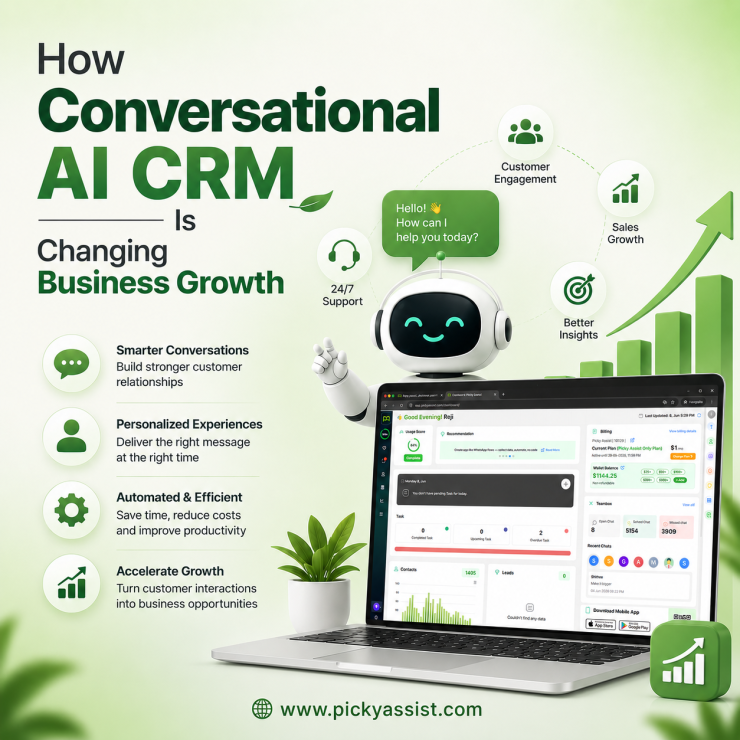
Customer relationships are no longer managed through spreadsheets, delayed follow-ups, or disconnected tools. They are built in real time through conversations. This is exactly where the concept of Conversational AI CRM becomes critical.
It merges artificial intelligence, conversational interfaces, and customer relationship management into a single system that doesn’t just store data, but actively drives customer interactions, sales decisions, and support outcomes.
For modern businesses, especially those operating in messaging-first markets like WhatsApp, this shift is not optional anymore. It is structural. Platforms like Picky Assist are accelerating this transformation by turning WhatsApp conversations into structured CRM-driven workflows that can scale.
What is Conversational AI CRM?
Conversational AI CRM is a modern customer relationship management system that uses AI-driven conversations to manage, qualify, and convert customers across channels like WhatsApp, chat, and web messaging.
Unlike traditional CRMs that depend heavily on manual data entry and static records, AI CRM systems actively:
- Engage customers in real time
- Understand intent through AI
- Automate responses and follow-ups
- Update CRM records automatically from conversations
- Drive sales and support workflows through chat
In simple terms, it is a CRM that talks, listens, learns, and acts.
Why Traditional CRM Systems Are Reaching Their Limit?
Traditional CRM systems were built for a different era, when communication was slow, linear, and mostly email-based.
Today, that model breaks down because:
- Customers expect instant replies
- Conversations happen across multiple channels
- Sales cycles are driven by real-time engagement
- Manual data entry slows teams down
As a result, most businesses struggle with:
- Incomplete customer data
- Missed follow-ups
- Disconnected conversations
- Low visibility into sales pipelines
This gap is exactly what Picky Assist Conversational CRM solves.
How Conversational AI CRM Works in Real Business Environments?
A modern AI CRM is not a single tool. It is a connected intelligence layer built on three core capabilities.
1. AI-Powered Conversation Understanding
The system first interprets what the customer is saying using AI chat models.
It analyzes:
- Intent (what the user wants)
- Context (previous interactions)
- Sentiment (urgency or emotion)
- Entities (product, service, issue type)
This ensures the system understands more than just keywords. It understands meaning.
2. Automated CRM Data Capture from Conversations
Instead of manual updates, every conversation automatically updates the CRM.
This includes:
- Customer details
- Lead status
- Purchase interest
- Interaction history
- Follow-up requirements
This is where WhatsApp CRM becomes especially powerful, as most customer interactions now begin and happen inside WhatsApp.
3. Action-Based Automation Engine
Once data is captured, the system triggers actions such as:
- Assigning leads to sales teams
- Sending follow-up messages
- Updating pipeline stages
- Triggering workflows or notifications
This turns conversations into operational outcomes.
Conversational AI CRM vs Traditional CRM
Understanding the difference is key for decision-makers.
| Feature | Traditional CRM | Conversational AI CRM |
| Data entry | Manual | Automated from conversations |
| Customer interaction | Separate tools | Built into CRM |
| Response time | Delayed | Real-time |
| Lead handling | Static pipelines | Dynamic conversation-based routing |
| Intelligence | Historical data | Live AI-driven insights |
The shift is clear: Traditional CRM records what happened. AI CRM influences what happens next.
Why WhatsApp Is Driving Conversational AI CRM Adoption?
Most conversational CRM systems today are evolving around messaging platforms, especially WhatsApp. This is because WhatsApp has become the primary channel where:
- Customers ask questions
- Leads initiate conversations
- Support requests are raised
- Purchase decisions are influenced
A WhatsApp CRM integrated with AI allows businesses to:
- Respond instantly at scale
- Manage customer journeys inside chat
- Convert conversations into structured pipelines
- Eliminate dependency on multiple disconnected tools
This makes WhatsApp not just a messaging channel—but a full customer engagement system.
Core Capabilities of a Conversational AI CRM
1. Real-Time Lead Qualification
Instead of manually filtering leads, AI systems ask qualifying questions automatically and segment users based on intent and readiness.
2. Intelligent Routing
Leads are assigned based on:
- Product interest
- Location
- Priority level
- Language
- Deal size
This ensures the right team handles the right conversation.
3. Automated Follow-Ups
No lead is forgotten. The system automatically:
- Sends reminders
- Re-engages inactive users
- Nudges prospects at the right time
4. Unified Customer View
All interactions are stored in a single timeline:
- WhatsApp chats
- Support history
- Sales interactions
- Campaign responses
This creates a complete 360° customer profile.
5. AI-Based Conversation Handling
Conversational AI handles:
- FAQs
- Initial responses
- Product suggestions
- Basic troubleshooting
Human agents only step in when needed.
Real Business Use Cases of Conversational AI CRM
Sales Teams
- Faster lead qualification
- Automated pipeline updates
- Reduced response time
Customer Support
- Instant query resolution
- Ticket automation
- Reduced workload on agents
Marketing Teams
- Automated engagement campaigns
- Personalized messaging
- Behavioral targeting
E-commerce Businesses
- Order updates
- Abandoned cart recovery
- Product recommendations
Why Are Businesses Moving Toward Conversational AI CRM?
The adoption is not driven by trends. It is driven by operational pressure.
Businesses want:
- Faster response cycles
- Higher conversion rates
- Reduced manual workload
- Better customer experience
- Unified communication systems
An AI CRM solves all of these by turning communication into structured automation.
How Picky Assist Enables Conversational AI CRM for WhatsApp-First Businesses?
Modern businesses don’t just need CRM software, they need execution systems. With Picky Assist, AI CRM becomes practical at scale by enabling:
- WhatsApp-first customer engagement workflows
- AI-driven chatbot automation for lead handling
- CRM updates directly from conversations
- Automated routing and assignment rules
- Integrated follow-up and broadcast systems
Instead of switching between tools, businesses manage everything inside a single conversational ecosystem. This reduces friction and improves conversion efficiency significantly.
The Strategic Shift: From CRM Systems to Conversational Ecosystems
The biggest transformation happening in business technology is simple: CRM is no longer a system of record. It is becoming a system of interaction.
In this new model:
- Conversations generate data
- Data triggers actions
- Actions drive revenue
- AI manages execution
Conclusion
Conversational AI CRM represents a major shift in how businesses manage customer relationships. It replaces static data entry with dynamic conversations, manual follow-ups with intelligent automation, and fragmented tools with unified engagement systems. For businesses operating on WhatsApp and other messaging platforms, this is especially critical. The ability to convert conversations into structured CRM actions determines how efficiently a company can scale.
Platforms like Picky Assist make this transition practical by connecting AI chat, WhatsApp CRM, automation, and workflows into one unified system. The result is simple but powerful: better conversations, faster decisions, and higher conversions.
FAQs on Conversational AI CRM
1. What is Conversational AI CRM in simple terms?
It is a CRM system that uses AI to manage customer conversations and automatically update data, follow-ups, and workflows.
2. How is Conversational AI CRM different from traditional CRM?
Traditional CRM stores data manually, while Conversational AI CRM updates and acts on data automatically through conversations.
3. Why is WhatsApp important for Conversational AI CRM?
Because most customer interactions now happen on WhatsApp, making it a primary channel for real-time engagement and automation.
4. Does Conversational AI CRM replace human sales teams?
No, it enhances them by handling repetitive tasks and allowing teams to focus on high-value conversations.
5. What role does AI play in Conversational AI CRM?
AI understands intent, qualifies leads, routes conversations, and automates responses based on context.
6. Can Conversational AI CRM improve sales conversions?
Yes, by reducing response time and ensuring faster lead qualification and follow-ups.
7. Is WhatsApp CRM part of Conversational AI CRM?
Yes, WhatsApp CRM is a key component when customer interactions happen primarily on WhatsApp.
8. How does Picky Assist support Conversational AI CRM?
It connects WhatsApp conversations with CRM automation, AI chatbots, and workflow systems to streamline engagement and sales.




Add comment