
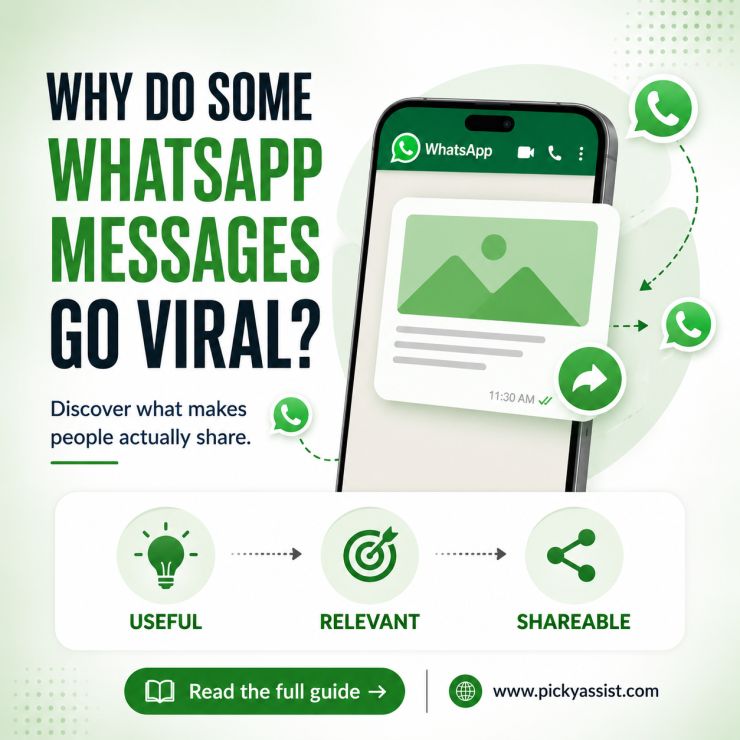
A common mistake businesses make is assuming that a WhatsApp message becomes effective simply because many people forward it. In practice, WhatsApp viral messages work when recipients find the content useful, entertaining, timely, or relevant enough to share voluntarily.
What are WhatsApp viral messages?
WhatsApp viral messages are messages that spread rapidly because recipients choose to forward or share them with others. They can include jokes, videos, festival greetings, useful tips, educational content, offers, community updates, or product recommendations.
For businesses, virality should not be the only goal. A message with 1,000 forwards but zero qualified leads may be less valuable than a useful message that generates 20 genuine customer conversations.
The dominant search intent behind “WhatsApp viral messages” is informational. People usually want to understand what viral messages are, why they spread, and how to create shareable content.
Why do some WhatsApp messages go viral?
There is no guaranteed formula for virality. However, highly shareable content usually has one or more of these characteristics:
1. It is useful
People naturally share information that can help others. Examples include:
- Buying guides
- Checklists
- Safety tips
- Short tutorials
- Industry insights
- Helpful reminders
2. It creates an emotional reaction
Humor, surprise, curiosity, nostalgia, excitement, and empathy can encourage sharing.
However, businesses should avoid misleading claims or fake urgency simply to increase engagement.
3. It is timely
Content becomes more relevant when it connects with something happening now. Festival messages, weather-related information, seasonal offers, event updates, and local announcements can benefit from good timing.
4. It feels personal
People are more likely to share content that reflects their interests, profession, location, language, or community.
5. It is easy to understand
A strong WhatsApp message usually communicates one clear idea. Keep the opening strong, avoid unnecessary text, and make the intended action obvious.
Types of viral messages in WhatsApp
| Message type | Why people share it | Business opportunity |
|---|---|---|
| Useful tips | Helps others | Build authority |
| Humor | Creates entertainment | Increase brand recall |
| Festival content | Feels timely | Strengthen relationships |
| Educational content | Provides knowledge | Generate qualified interest |
| Product recommendations | Helps decisions | Encourage referrals |
| Offers | Provides value | Generate sales |
| Community updates | Serves a group | Increase engagement |
The best business content combines value with a natural reason to share.
How to create shareable WhatsApp content?
Use this simple five-step process.
Step 1. Start with one problem
Choose a specific customer question.
For example:
“What should you check before buying an air conditioner?”
Avoid combining unrelated topics.
Step 2. Provide value first
Give customers something useful before asking them to buy.
You could provide a checklist, comparison, tip, guide, or practical recommendation.
Step 3. Keep it easy to share
Use short sentences and simple language.
A useful structure is:
Problem → Insight → Solution → Optional CTA
Step 4. Use a natural CTA
Instead of always saying “Buy now,” consider:
- “Save this guide for later.”
- “Share this with someone comparing products.”
- “Need help choosing? Reply YES.”
- “Want the complete checklist?”
Step 5. Test before scaling
Monitor:
- Delivery
- Reads
- Replies
- Clicks
- Leads
- Opt-outs
- Blocks
- Conversions
A campaign should be optimized around business outcomes, not just forwarding volume.
WhatsApp viral messages vs. business messaging
A person forwarding a message to friends is different from a business sending promotional messages through the WhatsApp Business Platform.
Businesses must follow WhatsApp’s Business Messaging Policy. Business-initiated conversations require approved message templates, while businesses can use free-form messages during the applicable 24-hour customer-service window after a customer messages them.
Therefore, “viral” does not mean businesses can send unsolicited messages to large contact lists. A safer approach is:
Relevant audience → appropriate permission → valuable content → compliant message → genuine engagement → measurable conversion.
Real-world scenario
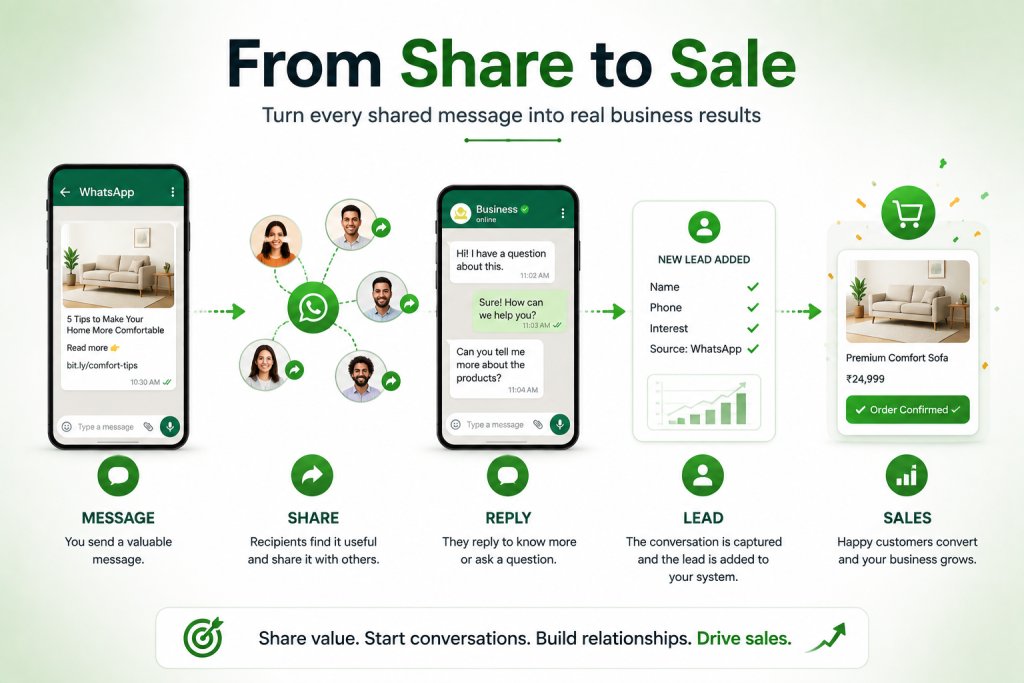
Scenario: A furniture retailer receives around 300 WhatsApp inquiries every day.
Customers repeatedly ask:
- Which mattress should I choose?
- What firmness is suitable?
- What size should I buy?
- How long does it last?
- Is there a warranty?
Instead of answering the same questions manually, the retailer creates:
“5 Things to Check Before Buying a Mattress.”
The message provides useful information and ends with:
“Know someone shopping for a mattress? Share this guide with them.”
If a customer replies, automation can ask about mattress size, firmness, and budget. The conversation can then move to a sales agent when personal assistance is required.
Here, shareable content creates attention, automation captures intent, and human agents handle complex conversations.
Common mistakes with viral messages
1. Confusing reach with results
Why it happens: Forward counts look impressive.
Consequence: Businesses cannot determine whether the campaign generated value.
Better approach: Track replies, clicks, leads, appointments, orders, and revenue.
2. Sending the same message to everyone
Why it happens: Mass distribution seems efficient.
Consequence: Irrelevant content can reduce engagement.
Better approach: Segment audiences based on interests, purchase history, location, or customer lifecycle.
3. Making every message promotional
Why it happens: Businesses focus on immediate sales.
Consequence: Customers may disengage from repetitive promotions.
Better approach: Balance educational, useful, entertaining, and promotional content.
4. Ignoring WhatsApp’s messaging rules
Why it happens: Teams treat WhatsApp like unrestricted SMS.
Consequence: Messages may fail, templates may be rejected, or customer quality signals may suffer.
Better approach: Check current WhatsApp requirements before launching campaigns.
5. Measuring only virality
Why it happens: Shares are easy to notice.
Consequence: High reach may hide poor conversion.
Better approach: Connect campaigns to CRM and conversion metrics.
How can businesses automate viral content campaigns?
Shareable content becomes more valuable when businesses can manage the conversations it generates.
A WhatsApp automation workflow can:
- Send approved campaign content to a relevant audience.
- Capture keyword-based replies.
- Answer common questions automatically.
- Recommend relevant products or services.
- Collect lead information.
- Record conversations in a CRM.
- Transfer complex cases to human agents.
Picky Assist can support this type of workflow by connecting WhatsApp broadcasts, chatbots, automated funnels, CRM processes, and human handoffs.
How to measure a viral WhatsApp campaign?
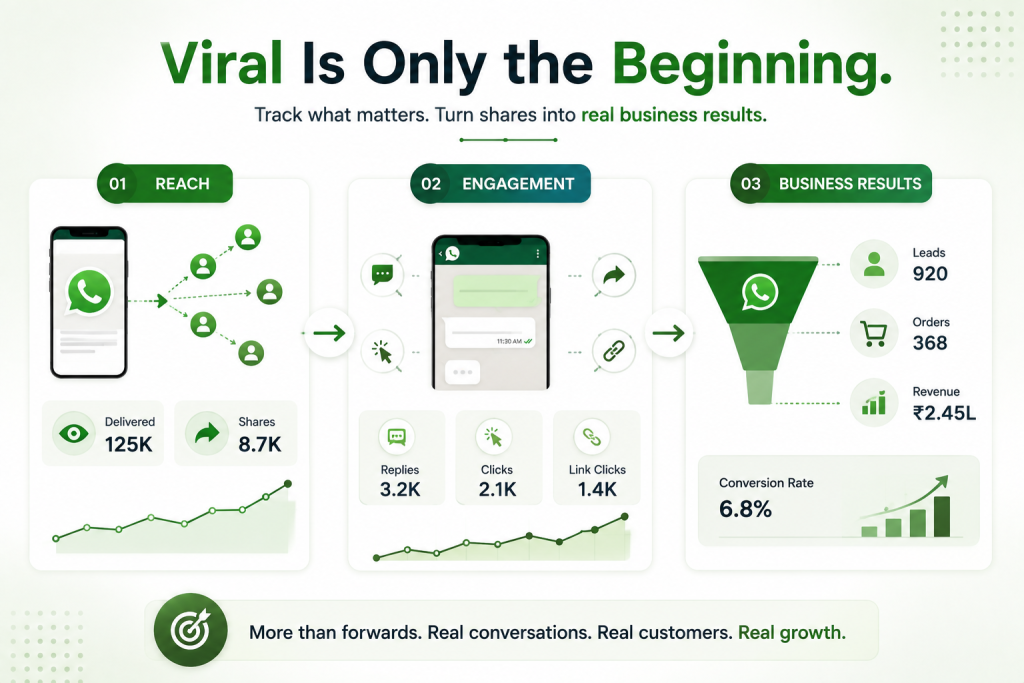
Don’t define success only by forwards. Measure three levels:
Distribution
- Delivered messages
- Reads
- Shares or forwards where measurable
Engagement
- Replies
- Clicks
- Product inquiries
- Keyword responses
Business outcomes
- Qualified leads
- Appointments
- Orders
- Revenue
- Repeat purchases
A smaller campaign with high-intent customers can outperform a campaign with much larger reach.
FAQs on WhatsApp Viral Messages
WhatsApp viral messages are messages that spread rapidly because recipients voluntarily share them. They can include entertainment, useful information, greetings, videos, offers, or educational content.
There is no guaranteed formula. Make the message useful, timely, emotionally relevant, easy to understand, and naturally worth sharing.
People use them for entertainment, information, greetings, community communication, recommendations, and discussions. Businesses can also use shareable content for awareness and engagement while following applicable WhatsApp rules.
Yes, businesses can create shareable content, but they must follow WhatsApp’s Business Messaging Policy. Business-initiated messaging through the WhatsApp Business Platform requires approved templates where applicable.
No. A bulk message describes distribution to multiple recipients. A viral message describes content that spreads through voluntary sharing.
They can increase awareness and engagement, but virality does not guarantee sales. Conversion depends on audience relevance, offer quality, customer intent, follow-up, and the overall buying experience.
You can connect shareable campaigns to a chatbot or automated workflow. The system can answer common questions, qualify leads, recommend products, and transfer complex conversations to human agents.

Add comment