
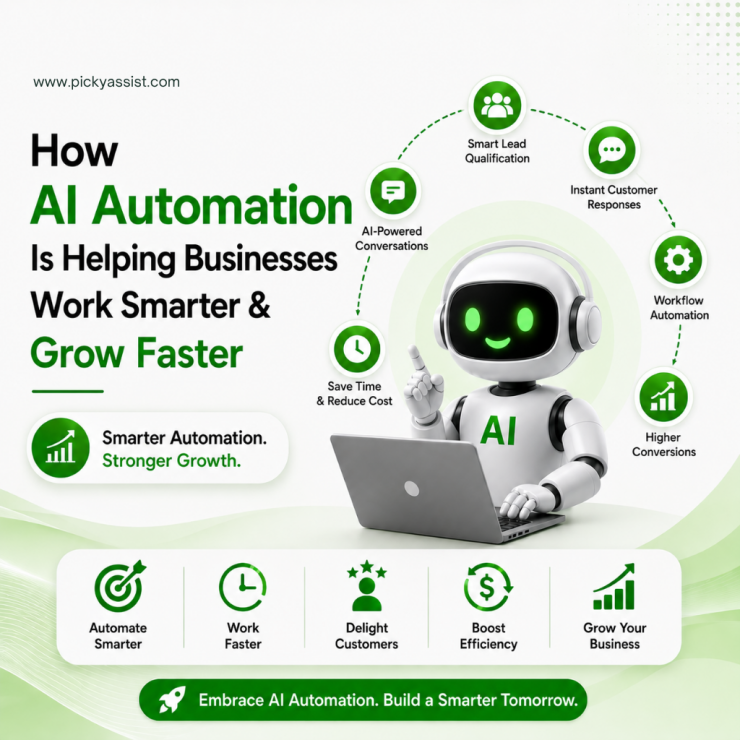
Traditional automation has helped organizations eliminate repetitive manual tasks for years. However, many processes still require human intervention because they involve conversations, decision-making, lead qualification, customer interactions, and workflow coordination. This is where AI process automation is changing the landscape.
Instead of simply automating predefined actions, artificial intelligence can analyze inputs, understand intent, make recommendations, trigger workflows, and support customer interactions in real time. As a result, businesses can automate more complex processes while improving efficiency and customer experience.
From customer support and lead management to workflow orchestration and conversational engagement, AI-powered automation is becoming a critical component of modern business operations.
In this guide, we’ll explore what AI process automation is, how it works, its benefits, real-world use cases, implementation considerations, and how platforms like Picky Assist help businesses automate customer engagement and operational workflows through conversational channels.
What is AI Process Automation?
AI process automation refers to the use of artificial intelligence technologies to automate business processes that traditionally require human involvement.
Unlike conventional automation, which follows fixed rules, AI-powered systems can interpret data, understand context, recognize patterns, and respond dynamically.
Examples include:
- Automatically qualifying sales leads
- Responding to customer enquiries
- Routing conversations to the right department
- Triggering follow-up workflows
- Categorizing customer requests
- Scheduling appointments
- Managing customer communications
The goal is not simply to automate tasks but to improve how processes operate across the customer journey.
How AI Process Automation Differs from Traditional Automation?
Many businesses already use automation tools for repetitive activities. Traditional automation typically follows predefined instructions. For example: If a customer fills out a form:
- Create a contact
- Send a confirmation email
- Assign a sales representative
While effective, this approach lacks adaptability. AI process automation introduces intelligence into workflows. For example:
A customer sends a WhatsApp message asking about pricing. The AI system can:
- Understand the enquiry
- Identify customer intent
- Provide relevant information
- Qualify the lead
- Collect additional details
- Route the conversation appropriately
- Trigger follow-up workflows automatically
This creates a more personalized and responsive experience.
Why is AI Process Automation Becoming Essential?
Organizations are generating more customer interactions than ever before. Customers expect:
- Immediate responses
- Personalized experiences
- Consistent communication
- Faster issue resolution
At the same time, businesses face challenges such as:
- Limited resources
- Rising operational costs
- High enquiry volumes
- Increasing customer expectations
- Complex multi-channel communication
AI-powered automation helps bridge this gap. Businesses can maintain responsiveness while reducing manual workload and improving operational efficiency.
Benefits of AI Process Automation
Faster Response Times
Speed matters. Whether a prospect submits a website enquiry or sends a WhatsApp message, quick responses improve engagement and reduce lead leakage. AI can respond instantly, even outside business hours.
Reduced Manual Work
Teams often spend significant time handling repetitive tasks. Automation can reduce activities such as:
- Data entry
- Lead assignment
- Follow-up scheduling
- Customer routing
- FAQ responses
This allows employees to focus on higher-value work.
Improved Customer Experience
Customers want timely and relevant interactions. AI-driven workflows help businesses deliver consistent communication across multiple channels. This improves customer satisfaction while creating a more professional experience.
Better Lead Management
Many leads are lost because businesses fail to follow up consistently. AI-powered workflows help ensure that enquiries are captured, organized, tracked, and nurtured throughout the sales cycle.
Greater Scalability
As businesses grow, customer interactions increase. Automation enables organizations to handle larger volumes without proportionally increasing operational costs.
How AI Automation Supports Customer Engagement?
Customer engagement is one of the most impactful applications of AI. Modern customers interact through:
- Website chat
- Social media
- Mobile applications
Managing these interactions manually can quickly become overwhelming. AI automation helps businesses engage customers at scale while maintaining responsiveness. Examples include:
- Instant enquiry handling
- Automated lead qualification
- Customer onboarding
- Appointment booking
- Follow-up reminders
- Support ticket routing
These workflows help create smoother customer journeys.
The Growing Role of Conversational AI Automation
One of the fastest-growing areas of business automation is conversational AI automation. Instead of relying on static forms or email exchanges, businesses can interact with customers through natural conversations. Customers can ask questions, request information, book appointments, and receive assistance through messaging channels they already use.
Conversational automation is particularly effective because it reduces friction. Rather than navigating multiple systems, customers simply engage through chat.
Businesses benefit from:
- Faster engagement
- Higher response rates
- Improved customer experiences
- More efficient lead qualification
AI CRM Automation: Connecting Conversations with Customer Data
Automation becomes significantly more valuable when connected to customer relationship management systems. AI CRM automation combines intelligent workflows with customer data management. This allows businesses to:
- Capture customer information automatically
- Track interactions across channels
- Segment audiences
- Trigger personalized communication
- Monitor customer journeys
For example: A customer initiates a WhatsApp conversation. The system can automatically:
- Create a customer profile
- Record interaction history
- Qualify the lead
- Assign ownership
- Schedule future communication
Everything becomes centralized and trackable.
AI Workflow Automation Across the Customer Journey
Customer journeys rarely follow a straight path. A prospect may:
- Visit a website.
- Submit an enquiry.
- Request information via WhatsApp.
- Schedule a consultation.
- Receive follow-up communication.
- Become a customer.
- Require ongoing support.
AI workflow automation helps coordinate these touchpoints automatically. Instead of manually managing each step, businesses can create structured workflows that adapt to customer actions. This improves efficiency while maintaining consistency.
Practical Use Cases of AI Process Automation
Lead Qualification
AI can ask qualifying questions, collect information, and prioritize leads based on predefined criteria. This helps sales teams focus on high-potential opportunities.
Customer Support
Automated systems can answer common questions and route complex cases to human agents when necessary.
Appointment Scheduling
AI can coordinate availability, confirm appointments, and send reminders automatically.
Customer Onboarding
New customers can receive guided onboarding experiences through automated conversations.
Follow-Up Management
Businesses can automate follow-ups based on customer behavior and engagement levels.
AI Industrial Automation vs Business Process Automation
When discussing artificial intelligence, many people encounter the term AI industrial automation. Although related, the focus differs. AI industrial automation typically applies to manufacturing environments where AI supports:
- Equipment monitoring
- Predictive maintenance
- Production optimization
- Quality control
AI process automation in customer-facing businesses focuses more on:
- Customer engagement
- Lead management
- Workflow orchestration
- Communication automation
- Service delivery
Understanding this distinction helps businesses evaluate solutions that align with their operational goals.
How Picky Assist Supports AI Process Automation?
Picky Assist helps businesses automate customer engagement and communication workflows through a combination of CRM functionality, chatbot automation, and conversational channels. The platform enables organizations to streamline customer interactions without relying on disconnected systems.
Key capabilities include:
AI-Powered Conversational Engagement
Businesses can automate customer conversations through WhatsApp based AI chatbots and other supported communication channels.
CRM-Driven Workflow Automation
Customer interactions can be captured and managed within a centralized CRM environment.
Lead Qualification Automation
Businesses can automate information collection and lead routing processes.
Customer Journey Automation
Workflows can be designed to support customer acquisition, nurturing, onboarding, and engagement.
Team Collaboration
Customer conversations and engagement history can be managed within a unified inbox. By combining communication automation with customer relationship management, Picky Assist helps organizations create more structured and scalable customer engagement processes.
How to Evaluate an AI Process Automation Platform?
Before investing in automation technology, businesses should assess:
Communication Channels
Does the platform support the channels customers actually use?
CRM Integration
Can customer interactions be connected to customer records?
Workflow Flexibility
Can automation workflows be customized to fit business processes?
Scalability
Will the platform support future growth?
Reporting and Visibility
Can teams track performance and optimize workflows?
Ease of Use
Can non-technical teams build and manage automation processes? Selecting the right solution requires aligning technology with business objectives rather than focusing solely on features.
Conclusion
AI process automation is transforming how businesses manage customer interactions, workflows, and operational processes. Rather than simply automating repetitive tasks, modern AI systems help organizations respond faster, engage customers more effectively, and create scalable operational frameworks.
As customer expectations continue to evolve, businesses need solutions that combine automation, communication, and customer data management into a unified experience. Picky Assist supports this shift by helping businesses automate customer conversations, streamline workflows, centralize customer information, and improve engagement through conversational channels such as WhatsApp.
For organizations looking to improve operational efficiency while delivering better customer experiences, AI-powered automation is no longer a future consideration, it is becoming a competitive necessity.
FAQs on AI Process Automation
1. What is AI process automation?
AI process automation uses artificial intelligence to automate business processes that traditionally require human decision-making, communication, or analysis. It helps improve efficiency, reduce manual work, and streamline operations.
2. How is AI process automation different from traditional automation?
Traditional automation follows predefined rules and workflows. AI process automation can interpret information, understand intent, adapt to customer interactions, and make intelligent decisions based on context.
3. What are the main benefits of AI automation?
Key benefits include faster response times, reduced manual workload, improved customer experiences, better lead management, increased productivity, and greater scalability.
4. What is conversational AI automation?
Conversational AI automation enables businesses to interact with customers through messaging channels using automated conversations that can answer questions, collect information, qualify leads, and trigger workflows.
5. How does AI CRM automation improve customer management?
AI CRM automation connects customer interactions with CRM data, allowing businesses to automate lead capture, customer segmentation, follow-ups, communication workflows, and customer journey management.
6. Which industries benefit most from AI process automation?
Industries such as travel, real estate, healthcare, education, financial services, ecommerce, and professional services often benefit because they rely heavily on customer engagement and workflow management.
7. What should businesses look for in an AI process automation platform?
Businesses should evaluate communication channel support, CRM capabilities, workflow flexibility, reporting, scalability, integration options, and ease of implementation.
8. How does Picky Assist support AI process automation?
Picky Assist helps businesses automate customer engagement, lead qualification, CRM workflows, WhatsApp communication, customer journeys, and conversational experiences through an integrated automation platform.


Add comment