
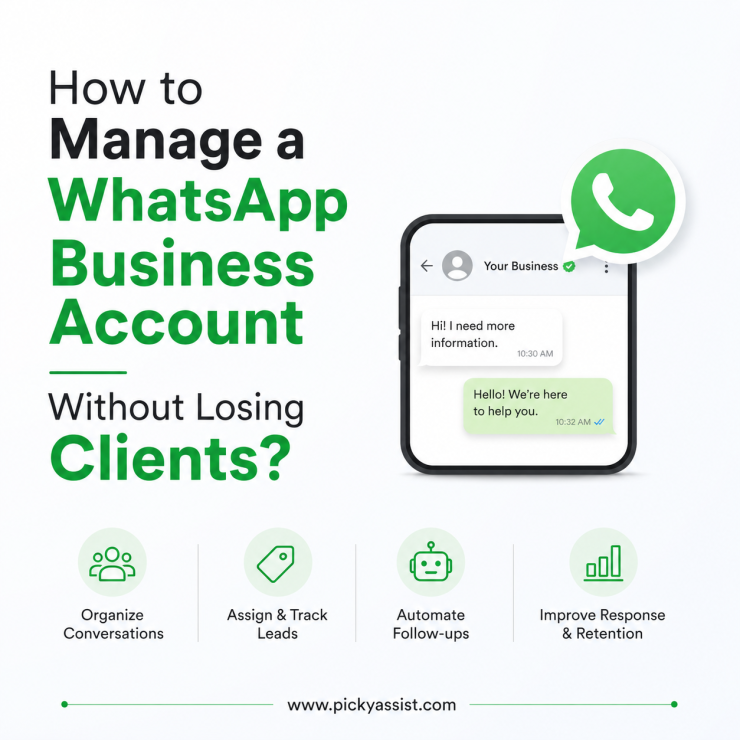
A real estate agency I worked with was running WhatsApp on a single Android phone shared by three agents. Every time a new project launched, the same thing happened: someone would reply to a site-visit enquiry at 11 PM, forget to update anyone else, and by morning two other agents had already replied to the same lead with conflicting availability and pricing. The customer, understandably, went with a competitor who seemed more organized. That’s not a WhatsApp problem. It’s a management problem and it’s the same one that shows up whether you’re a two-person shop or a 40-agent support team. How to manage WhatsApp business account without losing follow-ups? If the honest answer is “we check the app and hope nothing slips,” this guide is for you.
Managing a WhatsApp Business account well means combining three things, a structured inbox (labels, assignment, or a shared team inbox), pre-built response tools (quick replies, templates, catalogs), and a follow-up system that doesn’t rely on memory (automation or a CRM layer). The WhatsApp Business App can handle this manually up to roughly 3–5 conversations a day per person; past that, most businesses need the WhatsApp Business Platform (API) with a proper conversational CRM.
Why Does WhatsApp Business Get Unmanageable?
WhatsApp Business (the free app) was designed for a single owner-operator answering their own chats. It was never built for multiple people, multiple shifts, or lead follow-up cadences.
The failure pattern is almost always the same three things, in this order:
- No ownership. Any team member can reply to any chat, so nobody actually “owns” a lead. Follow-ups get assumed rather than assigned.
- No memory outside the chat window. Once a conversation scrolls up, context (what they asked for, what was quoted, what they were promised) is gone unless someone manually notes it elsewhere.
- No trigger to follow up. A lead who goes quiet for 48 hours doesn’t get flagged, they just disappear into the thread history until someone happens to scroll past them.
This is the real version of the question, how are you managing WhatsApp leads without losing customers? Most businesses aren’t losing customers to competitors. They’re losing them to their own inbox.
Managing the Inbox: Labels, Assignment, and Shared Access
If you’re on the free WhatsApp Business App, labels are your only structure. Use them, but know their ceiling.
- Labels work well up to about 15–20 active tags. Past that, staff stop applying them consistently because scrolling a long label list takes longer than just replying. Keep it to funnel stages (New Lead, Quoted, Follow-Up Due, Paid, Closed-Lost) rather than granular tags for every product line.
- The single-device login is the most common breakage point. WhatsApp Business App only runs reliably on one primary phone (plus limited linked devices). Teams that share logins across multiple phones regularly get logged out mid-shift, which is often the real reason “we missed the message” not a process failure, a login failure.
- A shared team inbox (via the WhatsApp Business Platform/API) solves ownership, because it lets you formally assign a conversation to a specific agent, see who last replied, and set an internal status separate from what the customer sees. This is the point where most businesses outgrow the free app not because of message volume, but because of accountability.
Setting Up the Account Itself
Before automation or CRM, the basics still matter, and they’re where a surprising number of accounts lose easy conversions:
- Business profile — category, address, hours, and a catalog link if you sell products. An incomplete profile is a soft trust signal that costs conversions on first contact, especially for unfamiliar numbers.
- Catalog — for product-based businesses, attaching a catalog means a lead can browse without you typing out prices in chat every time. This alone removes a large share of repetitive “how much for X” messages.
- Away messages and greeting messages — set for outside business hours at minimum. A lead who messages at 9 PM and gets silent until 11 AM the next day has, in our experience, a meaningfully higher chance of messaging a competitor in between.
- Quick replies — pre-saved answers to your 10–15 most repeated questions (pricing, delivery time, availability). This is manual automation, and it’s free, so there’s no excuse to skip it even before you invest in a bot.
Automating the Repetitive Layer Without Sounding Robotic
Automation removes the 60–70% of repetitive messages instead of replacing real conversations. In our experience running chatbots for clients, the ones that work best don’t try to sound human; they’re upfront about being a quick-response bot and hand off cleanly the moment a query gets specific. That handoff moment, not the automation itself, is usually where businesses lose the most leads if it’s not designed properly.
A practical split we use when scoping this for a client:
- Fully automate: hours, location, pricing tiers, catalog browsing, order status lookups, appointment booking.
- Bot-assisted, human-finished: custom quotes, complaints, anything involving negotiation.
- Never automate: the first message after a complaint. Even a well-designed bot response here reads as dismissive.
One operational detail that trips up a lot of first-time automation setups: WhatsApp’s 24-hour customer service window. Once a customer messages you, you can reply freely (including with your bot or free-text) for 24 hours from their last message.
After that window closes, you can only re-engage using a pre-approved template message, and templates fall into three categories like Marketing, Utility, and Authentication where, each with different approval rules and, on the API, different per-conversation pricing.
Confirm current Meta conversation-based pricing tiers for your region before quoting clients. Missing this window is the single most common reason a “the bot didn’t follow up” complaint turns out to actually be a template-approval gap, not a bot failure.
WhatsApp Business App vs. WhatsApp Business Platform (API)
| What’s the Best Use | WhatsApp Business App (Free) | WhatsApp Business Platform (API) |
|---|---|---|
| Best for | Solo owner or 1–3 person team | Any team with shared/assigned leads |
| Multi-agent access | Limited, single primary device | Full shared inbox with per-agent assignment |
| Lead follow-up tracking | Manual, via labels only | Automated reminders, CRM stage tracking |
| Chatbot / auto-qualification | Basic quick replies + away message | Full conversational bots, flows, funnels |
| Broadcast to past customers | Manual, one contact at a time | Segmented broadcast campaigns |
| Typical breaking point | ~15–20 active conversations/day | Scales to hundreds of agents/thousands of chats |
Platforms like Picky Assist sit on top of the WhatsApp Business Platform specifically to close the gaps in that right-hand column with shared inbox, automated follow-up reminders, and broadcast segmentation, without requiring an in-house developer to build with Meta’s API directly.
Managing WhatsApp Leads Without Losing Follow-Ups
Use this as a working checklist rather than a one-time setup:
- Every new chat gets a stage label within the first reply (New, Quoted, Follow-Up Due, Closed).
- No conversation sits untouched for more than 24 hours without either a reply or a scheduled reminder. This also happens to align with WhatsApp’s messaging window, so it’s a natural cadence to build around.
- One person (or one bot rule) owns “Follow-Up Due” as a queue that gets checked daily, not left to whoever happens to scroll past it.
- Quoted leads get an automatic nudge at 48–72 hours if there’s been no response, this single step recovers a meaningful share of “went quiet” leads in most businesses we’ve worked with, because most of those leads didn’t say no; they got busy and forgot.
- Closed-lost leads get tagged, not deleted, so they can be re-approached in a future broadcast rather than starting from zero.
FAQ on Managing WhatsApp Business Without Losing Customers
1. How do I manage a WhatsApp Business account with multiple team members?
Move off the free WhatsApp Business App once you have more than 2–3 people replying, since it only reliably supports one primary device. A WhatsApp Business Platform (API) connection with a shared team inbox lets you assign conversations to specific agents and track who owns each lead.
2. How are you managing WhatsApp leads without losing follow-ups?
The core fix is separating “reply now” from “follow up later”, label every lead by stage, set a fixed check-in cadence (24–72 hours), and use automated reminders so follow-up doesn’t depend on someone remembering to scroll back through old chats.
3. Can I use WhatsApp Business for free with a large team?
Technically only one number can be actively used per WhatsApp Business App account with limited linked devices, so large teams typically move to the WhatsApp Business Platform (API), which is built for multi-agent access, though it isn’t free per message.
4. What’s the difference between WhatsApp Business App and WhatsApp Business Platform?
The App is a free mobile app for small, single-operator use with manual tools like labels and quick replies. The Platform (API) is the paid, developer-facing version that supports chatbots, CRM integrations, team inboxes, and broadcast messaging at scale.
5. How do I stop losing WhatsApp leads to poor follow-up?
Set a rule that no quoted or interested lead goes more than 48–72 hours without a check-in message, and automate that reminder rather than relying on manual review, this is usually the single biggest recovery lever for “went cold” leads.
6. Do WhatsApp broadcast messages count against the 24-hour window?
No, messages sent outside the 24-hour customer service window must use a pre-approved template message regardless of whether they’re a one-to-one follow-up or a broadcast; only messages sent within 24 hours of the customer’s last message can be free-form.
7. Is a chatbot enough to manage WhatsApp leads, or do I still need a CRM?
A chatbot handles the repetitive first layer (FAQs, qualification, catalog browsing), but without a CRM layer behind it you still can’t track lead stage, assign ownership, or trigger follow-ups, the two work best paired, not as a replacement for each other.

Add comment